

When Your AC Stops Working, Here’s What to Do First
Air conditioning system repair can feel overwhelming — especially when it’s 90°F outside and your home is getting warmer by the minute.
Before diving into the full guide, here’s a quick answer to the most common question:
What should I check first when my AC stops working?
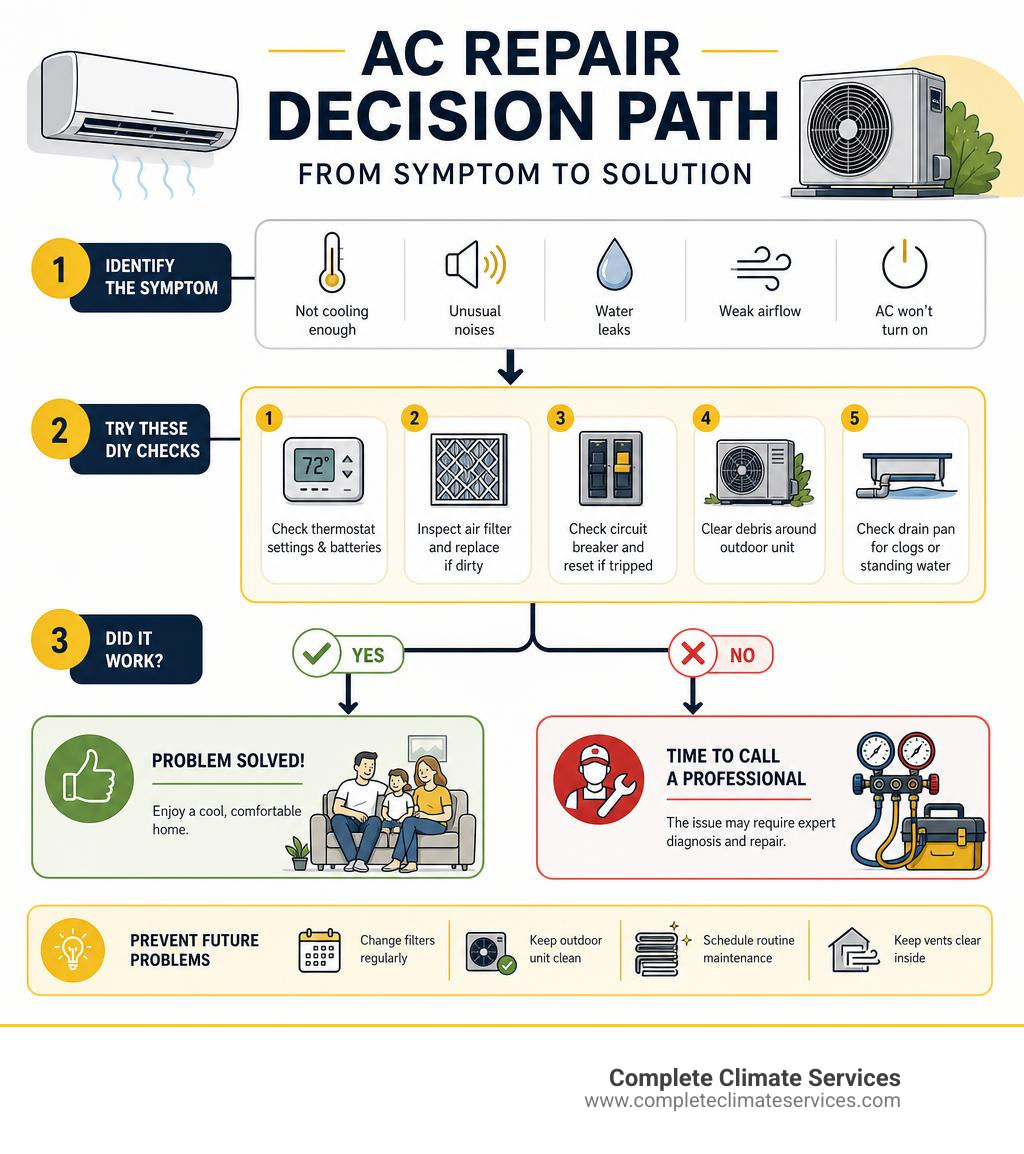
- Thermostat — Make sure it’s set to “Cool” and the target temp is lower than room temperature. Replace batteries if needed.
- Air filter — A clogged filter is one of the most common causes of poor cooling. Replace it if it’s dirty.
- Circuit breaker — Check your electrical panel for a tripped breaker and reset it once.
- Outdoor unit — Clear away leaves, debris, or anything blocking airflow around the condenser.
- Drain pan — If it’s full of water, the system may have shut off automatically due to a clog.
If none of those fix the problem, you likely need a professional diagnosis.
This guide covers everything from basic DIY troubleshooting to knowing when to call a licensed technician. You’ll learn how your AC works, which parts fail most often, what repairs cost, and how to keep your system running efficiently all season long.
I’m Michael Holcomb, co-founder and Operations Manager of Complete Climate Services, where my team and I have helped Baltimore-area homeowners and businesses navigate air conditioning system repair — from simple filter fixes to full compressor replacements. In the sections below, I’ll walk you through exactly what we see in the field every day, so you can make smart decisions fast.
How Your AC Works Before You Start Air Conditioning System Repair
Your air conditioner does not “make cold air” as much as it removes heat from your home and moves it outside. That is the heart of the refrigeration cycle.
In a central AC system, warm indoor air passes over a cold evaporator coil. Refrigerant inside that coil absorbs heat. The compressor then pumps that refrigerant to the outdoor condenser, where the heat is released outside. The refrigerant cools back down, passes through an expansion valve or metering device, and the cycle repeats.
The blower fan moves air through your ducts, the condenser fan moves outdoor air across the condenser coil, the thermostat tells the system when to run, and the condensate drain removes moisture pulled from the air.
Simple, right? Well, simple in the same way a car engine is simple once someone explains it. There are a lot of parts working together.
Main Components in a Central Air Conditioning System
The main parts include:
- Compressor: Pressurizes refrigerant and keeps it moving through the system.
- Condenser coil: Releases heat outdoors.
- Evaporator coil: Absorbs heat and moisture from indoor air.
- Expansion valve or metering device: Controls refrigerant flow into the evaporator coil.
- Air handler or furnace blower: Pushes cooled air through supply vents.
- Blower motor: Powers indoor airflow.
- Condenser fan motor: Cools the outdoor coil and compressor area.
- Contactor: Electrical switch that starts the outdoor unit.
- Capacitor: Gives motors the electrical boost they need to start and run.
- Drain pan and condensate line: Collect and remove water from humidity.
- Supply vents: Deliver cooled air.
- Return vents: Pull warm indoor air back to the system.
When one part fails, the whole system can struggle. A bad capacitor can stop the outdoor fan. A clogged filter can freeze the evaporator coil. A clogged drain can shut the system down. AC repair is often a chain-reaction mystery – and our job is to find the first domino.
Why AC Systems Stop Cooling or Perform Poorly
The most common reasons we see around Baltimore, Columbia, Towson, Catonsville, Dundalk, Ellicott City, and nearby areas include:
- Dirty or clogged air filters
- Blocked return vents
- Dirty evaporator or condenser coils
- Low refrigerant from a leak
- Frozen evaporator coil
- Failed capacitor
- Bad thermostat or dead thermostat batteries
- Clogged condensate drain line
- Faulty condenser fan motor or blower motor
- Tripped breaker or blown disconnect fuse
- Leaky ductwork
- Short cycling
- Compressor trouble
If your system is running but the air feels warm, start with our guide on why your AC is blowing warm air.
Common AC Types and Repair Differences
Not every cooling system is built the same. Repair methods vary depending on the equipment.
- Central AC: Most common in ducted homes. Repairs often involve capacitors, contactors, motors, coils, refrigerant, drains, and duct airflow.
- Heat pumps: Provide cooling and heating. Repairs may involve reversing valves, defrost controls, outdoor sensors, and refrigerant performance.
- Ductless mini-splits: Use indoor wall heads and outdoor units. Repairs may involve control boards, sensors, drains, line sets, and communication wiring.
- Window units: Smaller self-contained systems. Some basic cleaning is DIY-friendly, but sealed-system repairs are usually not cost-effective.
- Portable units: Often suffer from airflow restrictions, hose issues, drainage problems, and dirty filters.
- Wall units: Similar to window units but built into a wall sleeve.
- Inverter and communicating systems: More advanced and efficient, but they require proper diagnostic tools and manufacturer knowledge.
- Commercial units: Often rooftop or larger split systems. These require commercial HVAC experience and safety procedures.
Safe DIY Troubleshooting Before You Call for Service
Before calling us, there are a few safe checks homeowners can try. These steps can solve simple problems and help you describe the issue clearly if you do need service.
Basic Fixes Homeowners Can Safely Try
Try these in order:
-
Check thermostat settings
- Set it to “Cool.”
- Set the temperature at least 3 to 5 degrees below room temperature.
- Replace batteries if the display is blank or dim.
-
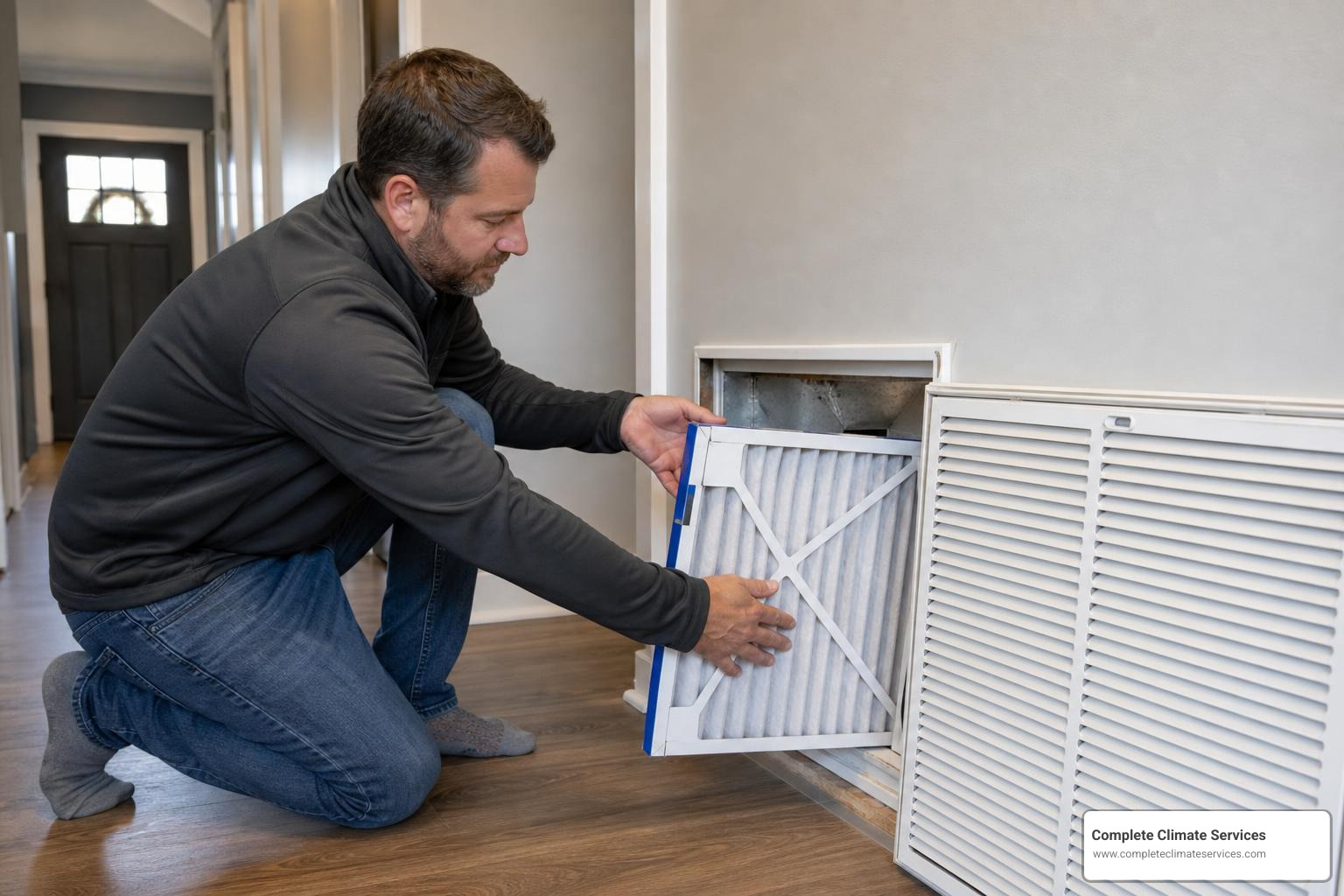
Replace the air filter
- If it looks gray, dusty, or matted, replace it.
- During heavy use, check filters monthly and replace every 1 to 3 months.
-
Open vents and clear returns
- Make sure furniture, rugs, curtains, or boxes are not blocking airflow.
- Do not close too many supply vents. It can increase system pressure.
-
Clear outdoor debris
- Remove leaves, grass clippings, mulch, and branches around the condenser.
- Keep about two feet of clearance around the outdoor unit.
-
Rinse the outside of the condenser carefully
- Turn power off first.
- Use gentle hose pressure only.
- Do not bend coil fins or use a pressure washer.
-
Check the drain pan
- A full pan can trip a float switch and shut the system off.
- If water is present, the drain line may be clogged.
-
Reset the breaker once
- If the breaker is tripped, reset it one time.
- If it trips again, stop. Repeated trips mean something is wrong.
For more step-by-step help, see our full AC troubleshooting guide. We also have practical tips for Columbia homeowners and quick AC fixes for Towson.
How to Turn Off Power Before Any AC Inspection
Safety first. AC systems use high voltage, and capacitors can store electricity even after power is off.
Before any visual inspection:
- Turn the thermostat to “Off.”
- Turn off the indoor air handler switch if one is installed near the unit.
- Go to the outdoor disconnect box near the condenser.
- Open the disconnect and pull the disconnect block or switch it off.
- Turn off the labeled AC breaker at the main electrical panel.
- Keep hands dry and stand on a dry surface.
- Do not touch exposed wires, terminals, or capacitor connections.
If you are not sure power is off, do not proceed. Voltage awareness is not optional. It is the difference between “I fixed it” and “I met the emergency room staff.”
How to Check a Tripped Breaker or Blown Fuse
At the main panel, look for a breaker sitting between “On” and “Off.” Flip it fully off, then back on once.
If it trips again, call a professional. Common causes include:
- Shorted motor
- Failed compressor
- Bad capacitor
- Loose wiring
- Ground fault
- Overheating equipment
- Dirty condenser coil causing high pressure
Some outdoor disconnect boxes contain fuses. A blown fuse can stop the outdoor unit even if the indoor blower runs. Testing fuses requires a multimeter and electrical knowledge. If you smell burning, hear buzzing, or see melted insulation, leave it alone and call us.
Diagnosing Parts During Air Conditioning System Repair
Many AC failures come down to electrical components, motors, airflow, or refrigerant performance. Some are obvious. Others require testing.

Air Conditioning System Repair Signs of a Bad Capacitor
A capacitor helps the compressor and fan motors start and run. A failing capacitor is one of the most common AC repair calls we see.
Signs include:
- Outdoor unit hums but fan does not spin
- Fan starts slowly or only sometimes
- Clicking from the outdoor unit
- AC starts, stops, then tries again
- Warm air from vents
- Bulged or swollen capacitor top
- Oil leaking from capacitor
- Breaker trips when AC starts
Capacitors are rated in microfarads, such as 35/5 MFD or 45/5 MFD, and voltage ratings must match system requirements. Replacement also requires safe discharge of stored electricity and correct wire placement. This is why we recommend professional service even though the part itself may look simple.
Learn more in AC Capacitor Replacement 101.
Air Conditioning System Repair Signs of a Bad Fan Motor
Your system may have a bad condenser fan motor, blower motor, or both.
Signs of a failing fan motor include:
- Outdoor fan not spinning
- Weak airflow from vents
- Loud grinding, squealing, or rattling
- Motor overheating
- Burning smell
- Fan blade wobbling
- System shuts down on high pressure
- Indoor coil freezes due to poor airflow
A technician will check amperage, voltage, bearings, capacitor condition, wiring, motor rotation, and motor speed. Replacement must match horsepower, voltage, RPM, rotation direction, frame size, and mounting style.
Compressor Problems That Require Expert Diagnosis
The compressor is the heart of the refrigeration system. When it struggles, symptoms can include:
- Loud buzzing or hard starting
- Breaker trips when cooling starts
- Outdoor unit runs but home does not cool
- Compressor overheats and shuts off
- Warm air from vents
- High electrical draw
- Locked rotor condition
- Refrigerant pressure imbalance
Compressor work is not DIY. It involves high voltage, refrigerant recovery, sealed-system repair, brazing, evacuation, and charging. Only EPA-certified technicians should handle refrigerant.
For warning signs, read AC Repair 101: Spotting Signs of a Problem with Your Compressor.
Fixing Leaks, Drain Clogs, and Refrigerant Line Insulation Problems
Not all AC “leaks” are refrigerant leaks. Many are water leaks from condensate drainage problems.
Signs of a Clogged AC Drain Line
As your AC removes humidity, water drains away through a condensate line. In humid Maryland summers, that line works hard.
Signs of a clog include:
- Water pooling near the indoor unit
- Ceiling stains if the air handler is in an attic
- Musty odor
- Full drain pan
- AC shuts off unexpectedly
- Float switch trips
- Gurgling drain sounds
- Algae or sludge in the drain line
- Water dripping indoors
A clogged drain can damage ceilings, flooring, insulation, and drywall. It is not glamorous, but neither is explaining to your ceiling why it is now a waterfall.
How a Drain Line Is Cleared Safely
Common drain-clearing methods include:
- Turning off the AC
- Using a wet-dry vacuum at the outdoor drain termination
- Opening the drain access tee if available
- Flushing with water or vinegar
- Cleaning the drain pan
- Removing algae buildup
- Checking the float switch
- Confirming the secondary drain is clear
A stiff wire can help with minor blockages, but use caution. Pushing too aggressively can damage fittings or push clogs deeper. Avoid harsh chemicals unless approved by your HVAC contractor, because they can damage piping and coils.
When to Replace Refrigerant Line Insulation
The larger copper refrigerant line, called the suction line, should be insulated. Replace insulation if it is:
- Missing
- Cracked
- Brittle
- Sun-damaged
- Loose
- Wet or moldy
- Allowing pipe sweating
- Exposing cold copper to outdoor air
Poor insulation wastes energy and can cause condensation damage. Replacement is usually done with correctly sized slit foam pipe insulation. Seams should be sealed, and outdoor sections should use UV-resistant wrap or outdoor-rated insulation.
Preventive Maintenance, Costs, and Repair vs. Replacement
Preventive maintenance is the least dramatic form of AC repair – and that is exactly why we like it. No panic, no sweating through dinner, no box fan pointed at your face like it owes you money.
Maintenance Tasks That Prevent AC Breakdowns
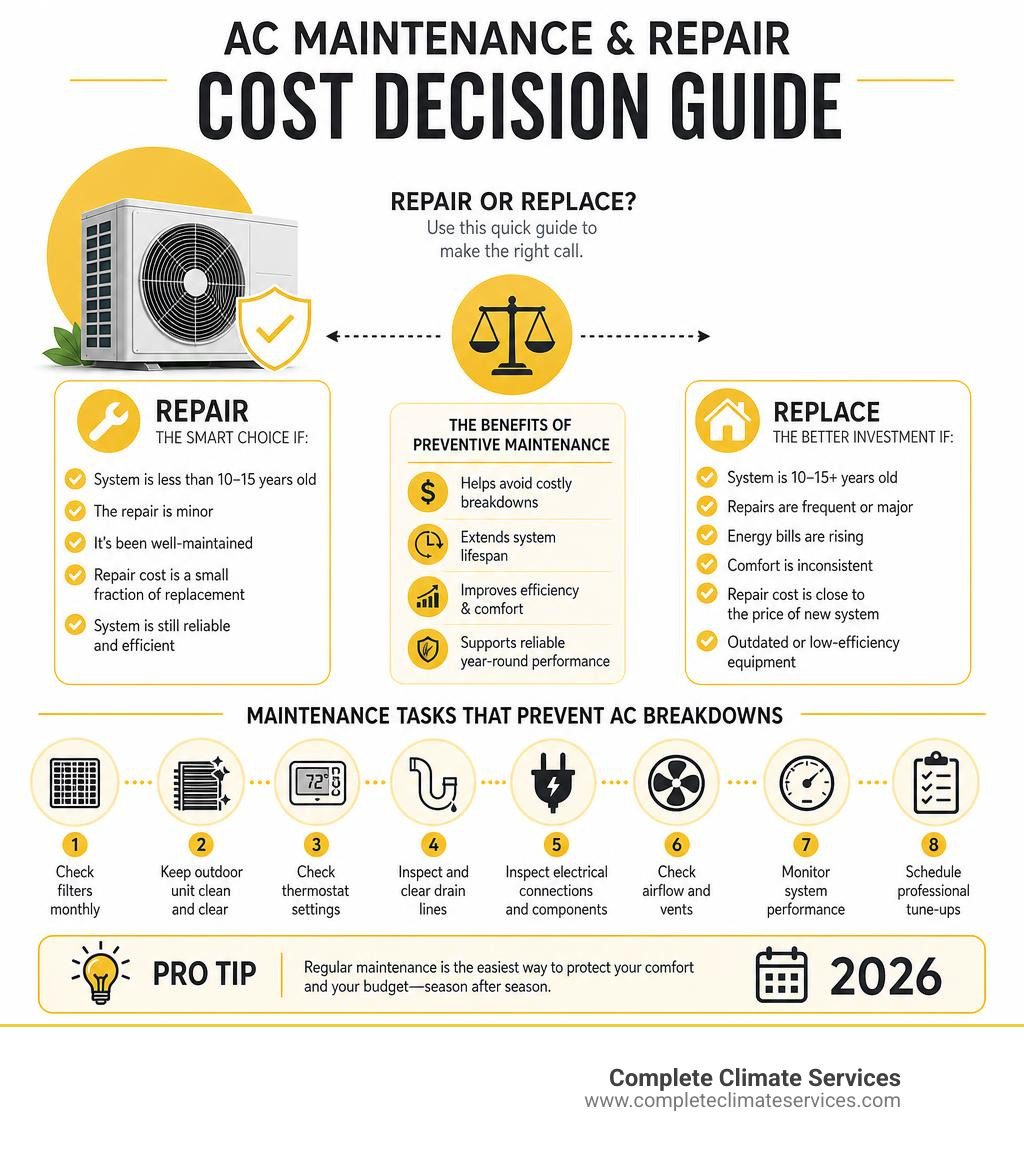
The best maintenance tasks include:
- Check filters monthly.
- Replace filters every 1 to 3 months, more often with pets, dust, or heavy use.
- Keep two feet of clearance around the outdoor unit.
- Rinse condenser coils gently when dirty.
- Keep supply and return vents open and clean.
- Clear condensate drains periodically.
- Inspect ductwork for loose connections or leaks.
- Test thermostat operation.
- Have electrical terminals inspected and tightened.
- Schedule a professional spring tune-up.
Professional maintenance should also include refrigerant performance checks, temperature split readings, airflow review, coil inspection, drain inspection, capacitor testing, contactor inspection, and safety control checks.
Seasonal AC Maintenance Schedule for 2026
For May 2026 and the rest of the cooling season, we recommend this schedule:
| Season | What to Do |
|---|---|
| Spring 2026 | Schedule AC inspection, test thermostat, check capacitor, clean coils, clear drain line |
| Early Summer 2026 | Replace filter, clear outdoor debris, confirm airflow at vents |
| Peak Summer 2026 | Check filters monthly, watch for short cycling, water leaks, warm air, or rising bills |
| After Storms | Remove branches, leaves, and debris from around the condenser |
| Fall 2026 | Clean around outdoor unit, replace filter, review repair history |
| Winter 2026 | Cover or store room AC units if applicable; do not cover a heat pump that operates in heating mode |
For window or room air conditioners, inspect seals at the start of the cooling season. Poor seals let warm air in and reduce efficiency.
How Much AC Repair Can Cost
AC repair costs vary based on the failed part, system type, access, age, warranty, and whether it is after-hours emergency work.
Typical ranges homeowners may see include:
- Basic diagnostic visit: often a service fee applies
- Minor electrical parts: often a few hundred dollars
- Capacitor replacement: commonly one of the lower-cost repairs
- Contactor replacement: usually moderate
- Fan motor replacement: higher due to parts and labor
- Refrigerant leak repair: can range widely depending on leak location
- Coil repairs or replacement: often more expensive
- Compressor replacement: one of the highest-cost repairs
- Major repairs: can reach into the thousands
Industry-wide, many AC repairs fall between about $150 and $1,500 or more, while major repairs such as compressor work can cost significantly more. We always recommend getting a clear diagnosis and written estimate before approving work.
When Repair Makes Sense vs. Replacement
Here are common decision factors:
| Repair Usually Makes Sense When | Replacement May Make More Sense When |
|---|---|
| System is under 10 years old | System is 10 to 15+ years old |
| Repair is minor | Repairs are frequent |
| Unit is still efficient | Energy bills keep rising |
| Parts are under warranty | Major parts are out of warranty |
| Comfort is still consistent | Rooms are uneven or uncomfortable |
| Repair cost is reasonable | Repair is over 50 percent of replacement value |
| Refrigerant type is current | System uses older R-22 refrigerant |
Two common rules of thumb:
- 50 percent rule: If repair costs more than 50 percent of replacement cost, replacement is worth considering.
- $5,000 rule: Multiply the repair cost by the system age. If the number is over $5,000, replacement may be the better long-term choice.
A well-maintained central AC system often lasts 15 to 20 years, but efficiency can decline after year 10. The best answer depends on your system, budget, comfort needs, and warranty status.
When to Call a Professional AC Technician
Some problems are safe to check. Others need a licensed HVAC technician.
Call us if you have:
- No cooling after basic troubleshooting
- Repeated breaker trips
- Burning smell
- Electrical buzzing
- Ice on refrigerant lines or evaporator coil
- Refrigerant leak signs
- Compressor noise
- Outdoor fan not running
- Indoor blower failure
- Major water leaks
- System short cycling
- Commercial HVAC failure
- Emergency cooling needs
For a deeper look at safety concerns, read The Hidden Risks of DIY Air Conditioning Repair.
Problems That Should Not Be DIY Repairs
Avoid DIY work on:
- Refrigerant leaks
- Refrigerant charging
- Compressor replacement
- High-voltage wiring
- Contactor replacement
- Motor wiring
- Sealed-system repairs
- Frozen evaporator coil diagnosis
- Recurring drain overflows
- Duct static pressure issues
- Control board replacement
- Inverter or communicating system diagnostics
Refrigerant work requires EPA Section 608 technician certification. Electrical repairs can be dangerous. And guessing at parts can get expensive fast.
What a Professional AC Diagnostic Should Include
A proper diagnostic should include:
- Thermostat verification
- Air filter and airflow check
- Temperature split measurement
- Capacitor testing
- Contactor inspection
- Electrical connection inspection
- Blower motor testing
- Condenser fan testing
- Refrigerant performance evaluation
- Leak detection when needed
- Coil condition inspection
- Drain line and pan inspection
- Safety control testing
- Written findings and estimate
Good diagnostics prevent repeat breakdowns. We do not like “parts darts,” where someone throws parts at a system and hopes one sticks.
How to Choose a Reliable AC Repair Company
Look for:
- Proper licensing and insurance
- Strong local reviews
- Clear communication
- Transparent pricing
- Upfront diagnosis
- No scare tactics
- Repair warranties
- Technicians who explain options
- Emergency availability
- Maintenance plans
- Experience with residential and commercial systems
Complete Climate Services has provided honest, reliable HVAC service for more than 20 years, serving Baltimore, Baltimore County, Anne Arundel County, Howard County, and nearby communities. We are proud of our 5.0 ratings across platforms, but what matters most is doing the job right.
For more guidance, see What to Look for in an AC Repair Company.
Frequently Asked Questions About Air Conditioning System Repair
Why is my AC running but not getting cold?
Common causes include:
- Dirty air filter
- Blocked return vents
- Dirty condenser coil
- Frozen evaporator coil
- Low refrigerant from a leak
- Failed capacitor
- Bad thermostat
- Faulty fan motor
- Compressor issue
- Leaky ductwork
Start with the thermostat, filter, vents, breaker, and outdoor unit. If the system still runs warm, schedule professional service. You can also read our full guide on why your AC is blowing warm air.
Can I repair my air conditioner myself?
You can safely handle basic tasks like:
- Replacing filters
- Replacing thermostat batteries
- Opening blocked vents
- Clearing return grilles
- Removing debris around the outdoor unit
- Checking the drain pan
- Resetting a breaker once
You should not DIY refrigerant, compressor, high-voltage electrical, motor wiring, or sealed-system repairs. If you are unsure, stop and call a professional. A small repair can become a big repair when safety steps are skipped.
How long does AC repair usually take?
Many minor AC repairs take 1 to 2 hours, including basic electrical part replacement or thermostat issues.
More involved work may take longer:
- Refrigerant leak search or coil cleaning: 2 to 4 hours
- Motor replacement: often 1 to 3 hours, depending on access and parts
- Compressor replacement or major sealed-system work: 4 to 6+ hours
- Complex commercial or communicating system diagnostics: varies by system
Time depends on parts availability, system type, access, and how much testing is needed after the repair.
Conclusion
Air conditioning system repair starts with simple checks: thermostat, filter, breaker, airflow, outdoor debris, and drain pan. If those do not solve the problem, the issue may involve electrical components, motors, refrigerant, drainage, ductwork, or the compressor.
Our advice is simple: try the safe basics, but do not gamble with high voltage or refrigerant. A proper diagnosis protects your system, your home, and your budget.
At Complete Climate Services, we provide residential and commercial HVAC repair, installation, maintenance, and emergency service throughout Baltimore and surrounding communities, including Brooklyn, Catonsville, Columbia, Dundalk, Ellicott City, Glen Burnie, Parkville, Pikesville, Rosedale, Towson, and more.
If your AC is blowing warm air, leaking water, tripping breakers, or refusing to turn on, we are here to help with honest service backed by more than 20 years of experience.
Ready to cool things down? Schedule professional AC repair services.

