

How Often to Change Your Furnace Filter for Better Airflow
How often to change furnace filter depends on filter thickness, household conditions, and how frequently the system runs. Check the filter every month and replace it based on its condition:
- Thin filters: typically need attention sooner because they have less material to hold debris.
- Thicker media filters: generally last longer because their deeper pleats provide more collection area.
- Pets, smoke, allergies, and heavy dust: can shorten any filter’s useful life.
- Use the table below for typical replacement intervals by filter type and household conditions.
A loaded filter limits airflow. That can make rooms less comfortable, raise energy use, and put extra strain on the blower and air conditioner.
Your calendar is a starting point, not the final answer. Replace the filter early if it looks dark and packed with debris, light does not pass through it, airflow drops, or the system starts cycling more often than usual.
Written by Michael Holcomb, Co-Founder and Operations Manager, Complete Climate Services. Complete Climate Services brings 20+ years of HVAC experience and 5.0 stars on Google to homeowners in Baltimore City, Baltimore County, Anne Arundel County, and Howard County.
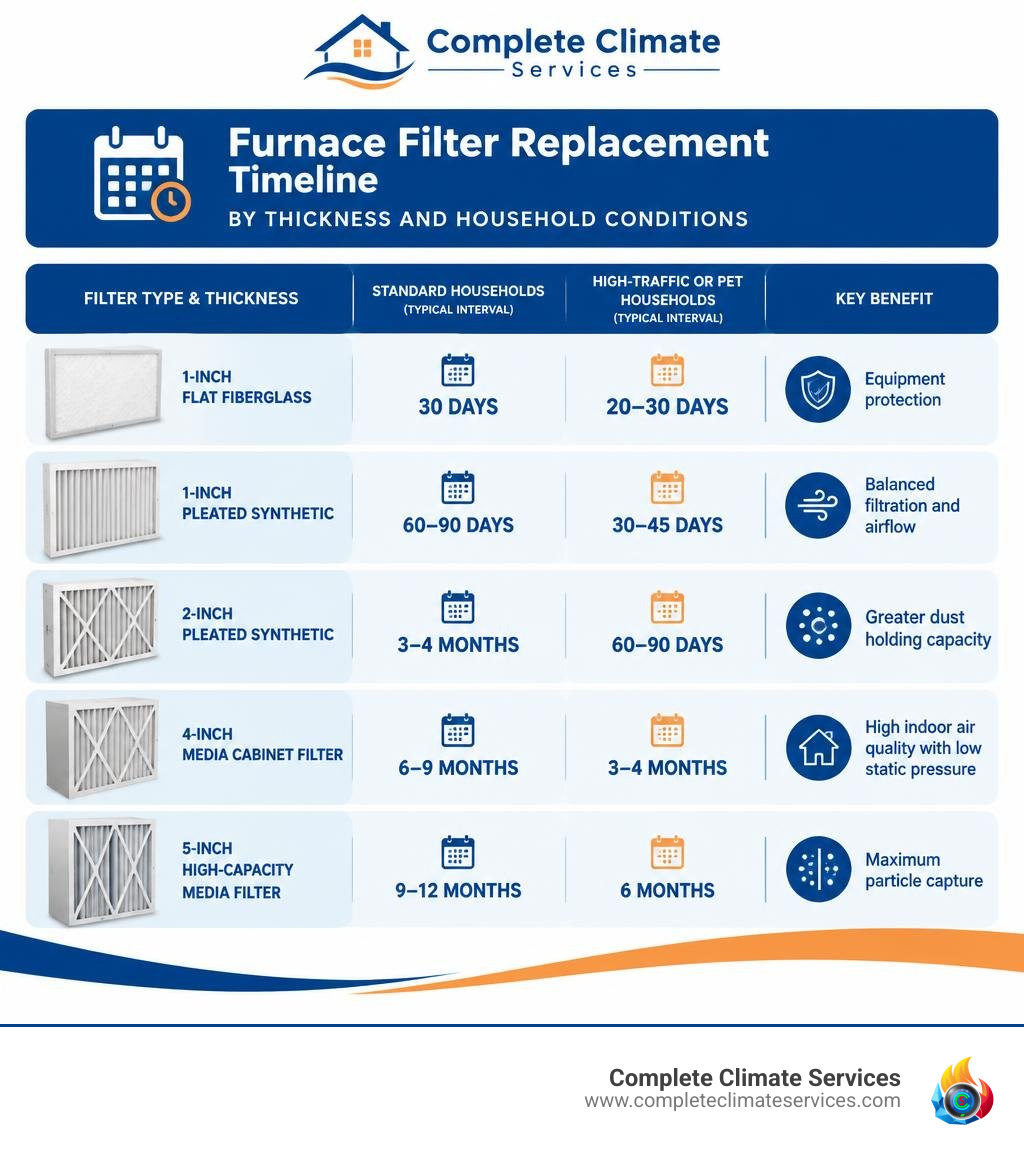
How Often to Change Your Furnace Filter by Filter Type
When deciding how often to change furnace filter, filter thickness is the single biggest mechanical factor. Thicker filters do not necessarily restrict more air; in fact, they contain significantly more surface area due to deeper pleating. More surface area allows the filter to capture massive amounts of dust, lint, and airborne debris before airflow resistance climbs to dangerous levels.
A standard flat panel filter has minimal surface area, meaning dirt quickly forms a solid sheet across the face. In contrast, deep pleated media spreads that dirt across several square feet of folded material. This difference directly impacts system static pressure, the resistance against which your furnace blower must push. When resistance spikes, your system works overtime, drawing more electricity and overheating critical parts.
| Filter Thickness | Filter Type | Standard Household Lifespan | High-Traffic / Pet Household Lifespan | Primary Benefit |
|---|---|---|---|---|
| 1-Inch | Flat Fiberglass | 30 Days | 20–30 Days | Cheap equipment protection |
| 1-Inch | Pleated Synthetic | 60–90 Days | 30–45 Days | Balanced filtration & airflow |
| 2-Inch | Pleated Synthetic | 3–4 Months | 60–90 Days | Greater dust holding capacity |
| 4-Inch | Media Cabinet Filter | 6–9 Months | 3–4 Months | High IAQ, low static pressure |
| 5-Inch | High-Capacity Media | 9–12 Months | 6 Months | Maximum particle capture, annual swap |
1-Inch and 2-Inch Flat vs. Pleated Filters
The 1-inch flat fiberglass filter is the quintessential “landlord special.” These inexpensive, see-through panels are designed primarily to catch large debris like hair and carpet fibers so they do not coat the blower motor wheel. They offer practically zero protection for your indoor air quality and load up very rapidly. Because they have little surface area, these filters load quickly and need close attention.
Pleated synthetic 1-inch and 2-inch filters represent a major upgrade. By folding synthetic fabric into an accordion shape, manufacturers dramatically increase the collection area. Their larger collection area helps them hold more particulate matter before airflow resistance rises.
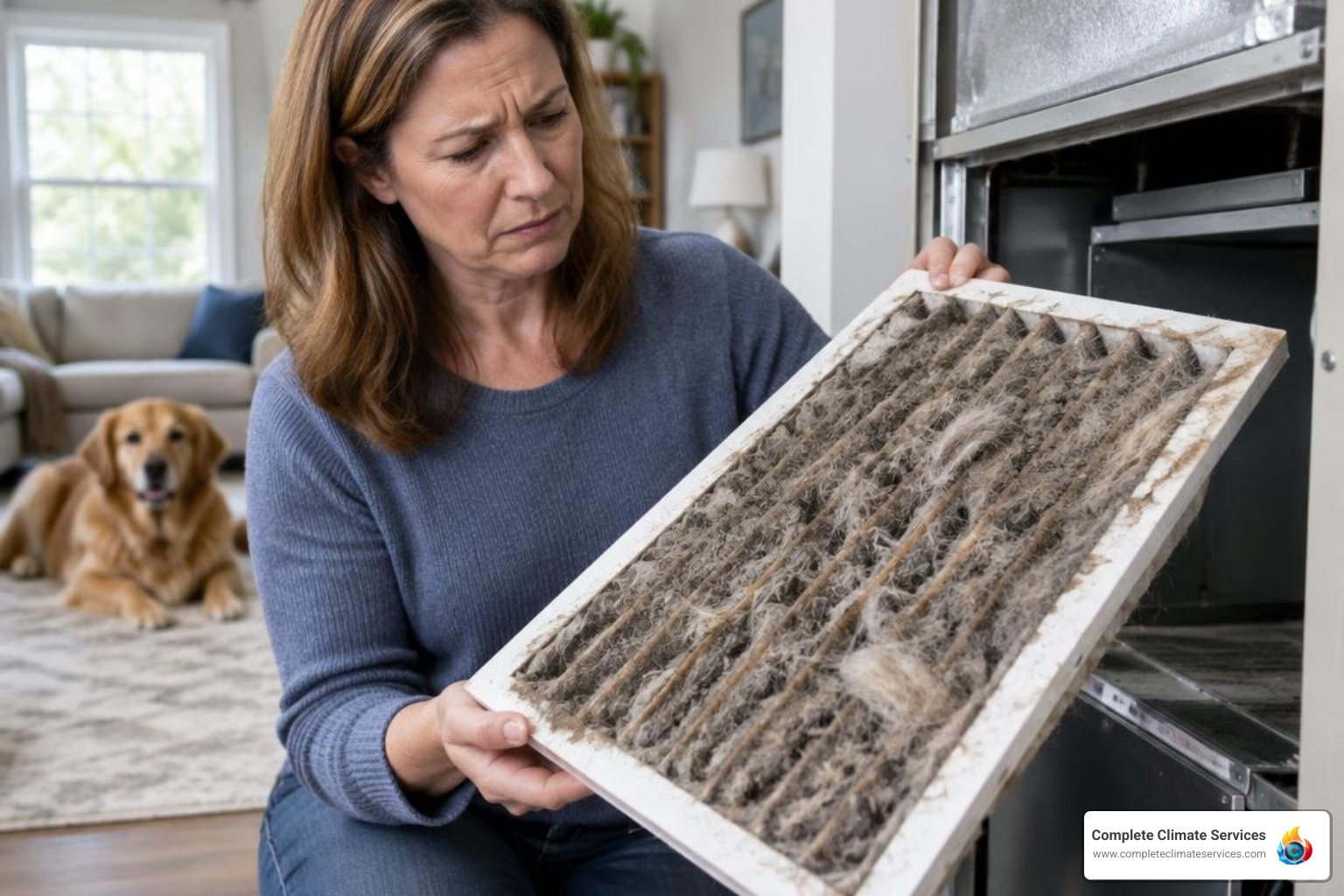
Routine inspection helps catch dust buildup before it restricts airflow.
4-Inch and 5-Inch Media Cabinet Filters
For superior filtration without choking your heating system, thick media cabinet filters are the gold standard. These filters (measuring 4 to 5 inches in depth) are housed in dedicated metal cabinets installed right next to the furnace return drop.
Because their accordion pleats are several inches deep, they provide up to ten times the surface area of a standard 1-inch filter. This added surface area helps the system maintain steadier airflow between replacements. In homes with significant dust or multiple pets, the filter can load more quickly, so its condition matters more than the calendar.
Household Factors That Speed Up Filter Replacement
While filter depth provides a reliable baseline, your actual living environment dictates how fast particulate matter accumulates. If your filter looks like a thick felt blanket after only a month, everyday lifestyle variables are actively accelerating the loading process.
Running your thermostat fan in continuous “ON” mode rather than “AUTO” pulls air through the filter 24 hours a day, 7 days a week. While this continuously scrubs airborne particles and evens out room temperatures, it also doubles or triples the rate of dust collection.
Similarly, home renovation projects generate immense clouds of drywall dust and wood shavings that can clog a brand-new filter in a matter of days. Keeping windows open during breezy spring and fall days invites pollen, outdoor soot, and street dust directly into your living space. Adopting indoor air quality tips helps minimize these external contaminants before they overwhelm your HVAC equipment.
Changing Your Filter With Pets or Smokers at Home
Pets bring endless joy into a home, but they also shed fur, dander, and dried saliva that get pulled directly into your return air vents. A single shedding dog or cat can easily cut a filter’s expected lifespan in half. Homes with multiple furry companions often need more frequent replacement because the filter captures more fur and dander. Following dedicated filters for pet owners protects both your family’s lungs and your heating unit.
Indoor tobacco or vape smoke accelerates filter degradation even faster. Smoke particles are exceptionally tiny, sticky, and laden with chemical residues. They coat the filter media in a tacky film that attracts dry dust, forming an impenetrable barrier across the pleats. If someone smokes inside your home, inspect the filter closely for odor, discoloration, and restricted airflow.
Winter Furnace Filter Changes for Baltimore Homes
During freezing winter stretches across Baltimore and surrounding communities like Towson and Columbia, your heating equipment runs far more frequently to maintain indoor comfort. Because the furnace operates for longer heating cycles, the volume of air circulating through the filter skyrockets.
Winter air is naturally cold and dry, which keeps dust, pet dander, and fabric fibers suspended in the air longer rather than settling on surfaces. This elevated particle load means your filter traps debris at an accelerated pace. A filter that performs well during milder weather may load much faster during sustained winter heating. Incorporating regular checks as part of your winter furnace problem prevention routine ensures your family stays warm without unexpected heating breakdowns.
Understanding MERV Ratings and System Airflow
Minimum Efficiency Reporting Value, or MERV, is the industry standard scale (ranging from 1 to 16 for residential and light commercial use) that rates a filter’s ability to capture airborne particles between 0.3 and 10 microns.
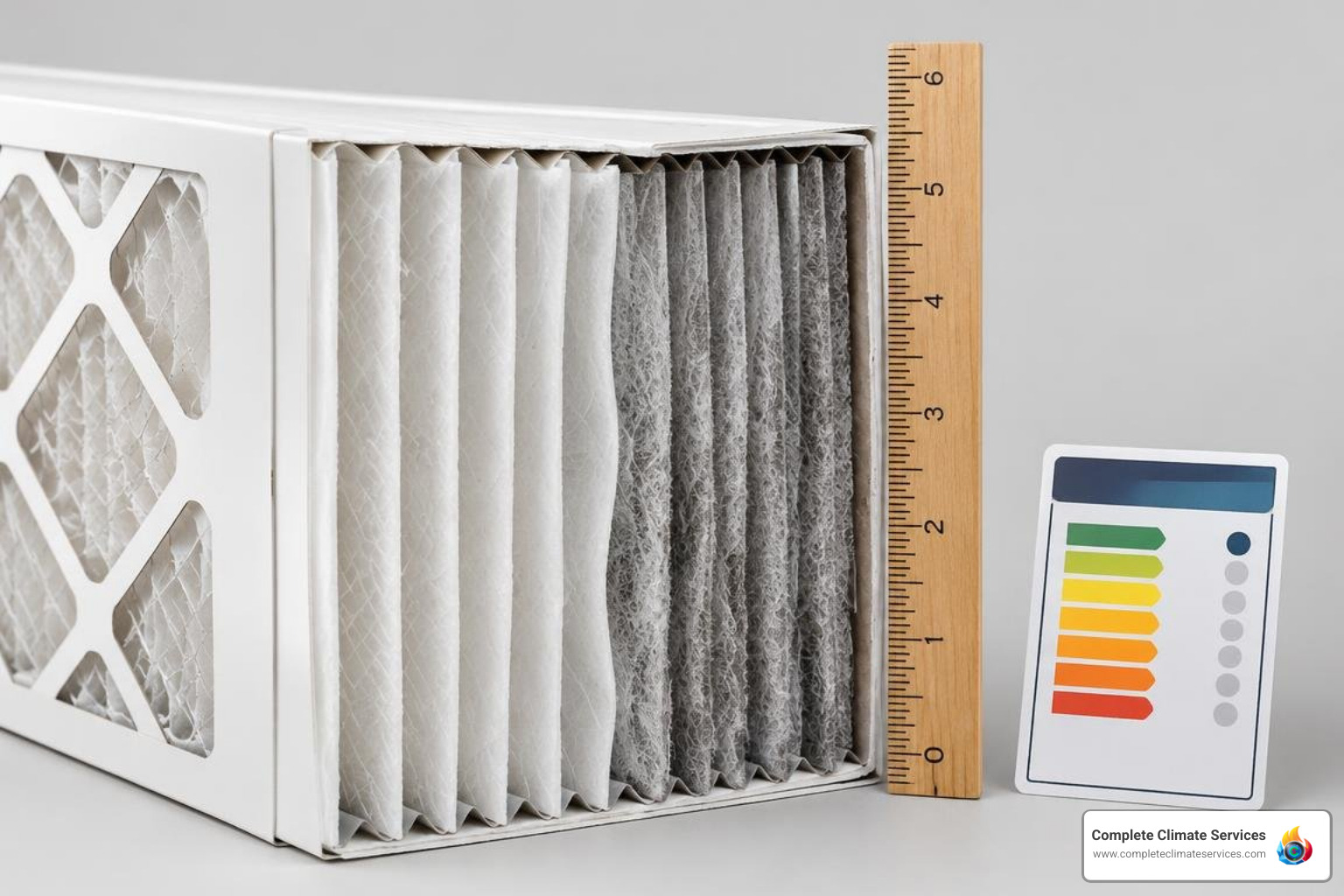
Many homeowners assume that buying the highest MERV rating available is always the best choice. However, higher filtration efficiency comes with a trade-off: increased airflow resistance. A dense filter media with tight fibers catches smaller particles, but it also demands more power from your blower motor to pull air through.
- MERV 1 to 4: Catches larger lint, dust, and carpet fibers. It mainly protects equipment.
- MERV 6 to 8: Captures many common household particles and is often a practical choice for standard residential systems.
- MERV 11: Provides stronger filtration for fine dust, pet dander, and some outdoor particles, making it a useful option for homes with pets or mild allergies.
- MERV 13: Offers more intensive filtration for smaller particles, smoke, and other airborne contaminants, but it may create more airflow resistance.
For general EPA indoor air guidance, focus on reducing indoor pollutants and using a filter your system can handle. Filter selection should balance filtration needs with steady airflow.
Older systems may struggle with high-resistance filters. Before moving to MERV 13, consult a professional about compatibility or explore indoor air quality services for help improving comfort and air quality.
Warning Signs and Consequences of a Clogged Furnace Filter
Ignoring your furnace filter can contribute to expensive HVAC problems. When a filter fills with debris, it can restrict airflow, reduce air cleaning, and add strain to equipment.
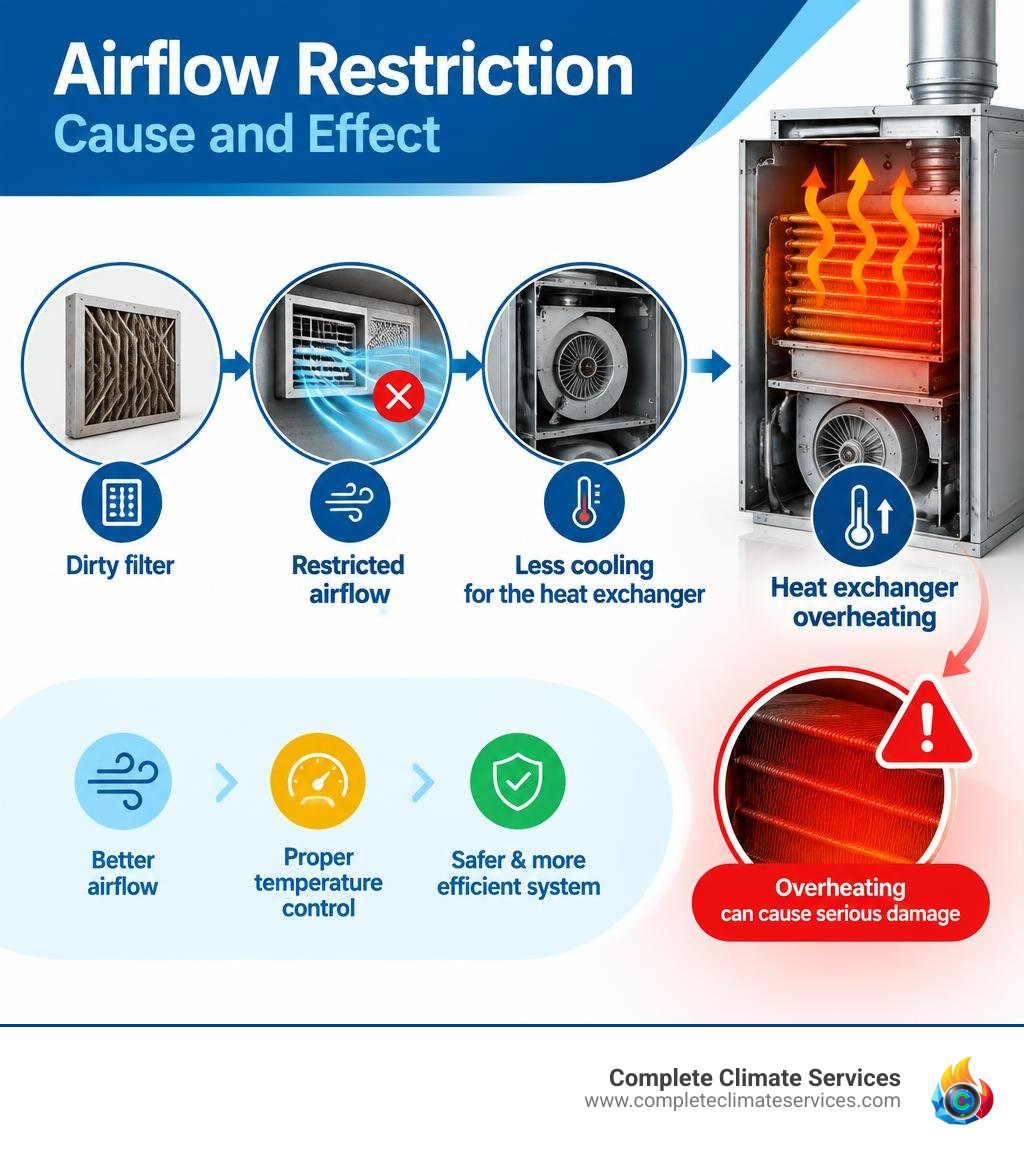
As airflow drops, heat can build up inside the furnace heat exchanger. Modern furnaces have high-limit safety switches that may shut the burners down to help prevent damage, causing the furnace to short-cycle, or turn on and off rapidly without properly warming the house. In summer, restricted airflow can also contribute to a frozen evaporator coil and compressor problems.
A severely clogged filter can force the blower motor to work harder and may shorten its operating life. Watching for common furnace problems such as whistling return grilles, uneven temperatures, and sudden utility-bill increases can help identify restricted airflow early. For persistent airflow or heating concerns, schedule furnace repair.
How to Perform a Visual Light Test
Never rely exclusively on calendar dates to decide when a filter needs replacement. A simple monthly visual inspection gives you definitive proof:
- Turn off your HVAC system at the thermostat or furnace power switch so the blower doesn’t pull loose dust into the cabinet.
- Slide the filter out of its slot.
- Hold the filter up against a bright overhead light, window, or flashlight.
- Look through the media: If light easily passes through the pleats and you can see the fabric weave, the filter still has usable service life. If the material looks gray, dark, and blocks light completely, it is fully loaded and needs immediate replacement.
- Check the cardboard frame for buckling, moisture, or gaps. Always ensure the airflow arrow printed on the frame points directly toward the furnace blower compartment when installing the new one.
Disposable vs. Washable Filters
While disposable pleated filters are the most popular choice, some homeowners opt for electrostatic washable filters. Washable filters feature aluminum frames with multi-layered woven polypropylene media that generate a static electric charge to attract dust.
While washable filters eliminate recurring purchases, they come with substantial caveats:
- They must be washed regularly using low-pressure water and without harsh detergents.
- They must be completely dry before you reinstall them into your furnace.
- Reinstalling a damp washable filter introduces moisture into ductwork, which can encourage mold, mildew, and bacterial growth.
- Their filtration efficiency is typically lower than that of many modern pleated disposable filters.
Frequently Asked Questions About Furnace Filter Maintenance
Can running the HVAC fan continuously clog the filter faster?
Yes. When your thermostat fan is set to “ON,” the blower motor circulates household air through the filter even when the furnace is not actively heating. That increased airflow can collect dust more quickly, so inspect the filter more often. Change it when it looks loaded or airflow noticeably drops.
How often should I change my furnace filter in winter?
Winter heating can move more air through the filter, especially during prolonged cold weather in Baltimore. Replace it sooner if it appears dark, blocks light, or coincides with weaker airflow. Homes with pets, smoke, or heavy dust may need more frequent changes.
Can a dirty filter cause my furnace to short cycle?
Yes, restricted airflow from a clogged filter can contribute to overheating and trigger the furnace’s safety controls. That may cause repeated short heating cycles instead of a normal run time. Replacing the filter is a sensible first step, but recurring short cycling needs professional diagnosis.
What happens if I accidentally put the filter in backwards?
Furnace filters are designed for airflow in one direction. If the arrow points away from the furnace, the filter media can buckle or collapse and may not protect the system as intended. Reinstall it with the arrow pointing toward the blower compartment.
Why is my new furnace filter getting dirty in just two weeks?
A filter that darkens quickly may be collecting dust from unsealed return ducts, renovation debris, candles, fireplaces, or nearby construction. If rapid darkening occurs with a burning smell or other furnace symptoms, arrange a professional inspection. This can help identify whether furnace ignition failure, a combustion concern, or an electrical concern is contributing to the problem.
Conclusion
Keeping your furnace filter clean is the single easiest, most cost-effective maintenance task you can perform to protect your home’s heating and cooling system. By matching your replacement schedule to your specific filter thickness, monitoring household factors like pets and winter runtimes, and selecting an appropriate MERV rating, you ensure reliable comfort and lower monthly utility bills.
If you are experiencing uneven heating, unusual furnace noises, or persistent airflow issues, Complete Climate Services is here to help. Contact us to schedule furnace services and help keep your heating system running safely and efficiently all season long. You can also contact our team with questions about your home’s heating or airflow.
Complete Climate Services LLC · 204 S Chapel St, Baltimore, MD 21231 · (443) 898-4747

