
When Your AC Stops Working, a Bad Capacitor Is Usually Why
AC capacitor replacement is one of the most common and most overlooked fixes in home cooling. In fact, many HVAC technicians report that failed capacitors are behind a large share of AC repair calls.
Here’s a quick overview of what you need to know:
| Topic | Quick Answer |
|---|---|
| What it does | Stores and releases energy to start your compressor and fan motors |
| Signs it’s failing | Humming, warm air, AC won’t start, fan not spinning |
| Typical lifespan | 8-10 years (shorter in hot climates) |
| Replacement cost | $150-$450 including parts and labor |
| DIY or pro? | DIY is possible but carries serious shock risks |
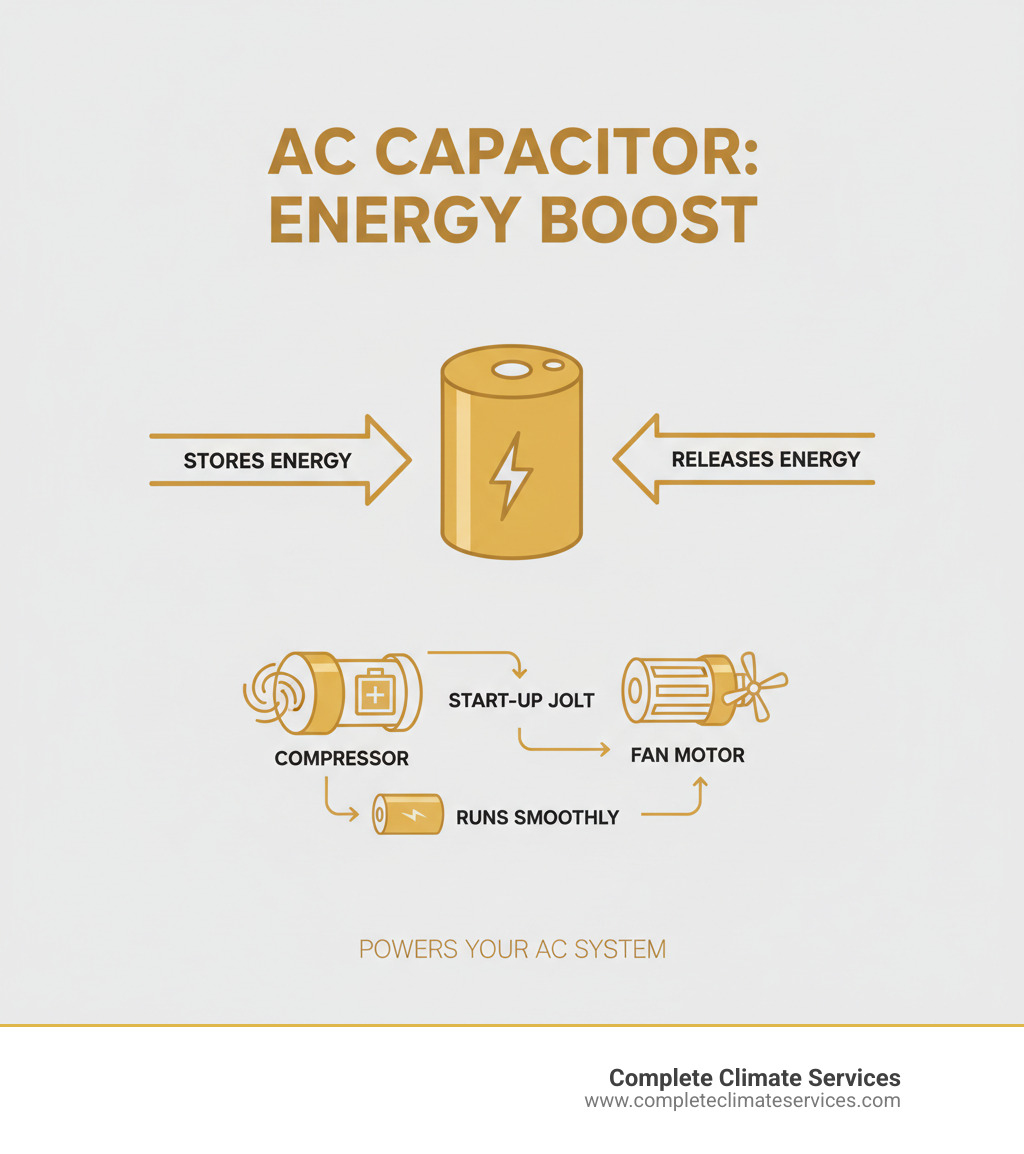
Your AC capacitor is a small cylindrical part inside the outdoor condenser unit. You can think of it like a quick-charge energy source. It gives the compressor and fan motors the boost they need to start, then helps them run properly. When the capacitor goes bad, the entire system may stop working, often right when you need cooling most.
The tricky part? A bad capacitor does not always show up as a sudden failure. Sometimes the AC simply struggles, running less efficiently, cycling on and off, or blowing air that is not quite cold enough. Over time, that extra strain can damage the compressor and lead to repairs that cost thousands.
At Complete Climate Services, we help Baltimore-area homeowners handle AC capacitor replacement as part of everyday HVAC repair. In this guide, you’ll learn how to spot the warning signs, understand the risks, and replace the part as safely as possible.
Signs You Need an AC Capacitor Replacement
When April 2026 rolls around and the first heatwave hits the Baltimore area, you don’t want to be caught with a cooling system that hums but won’t start. Because the capacitor provides that initial “kick” of energy, its failure often presents as a mechanical struggle.
One of the most common signs is a loud humming noise coming from your outdoor unit. This happens when the motor is receiving some power but doesn’t have enough torque to actually start spinning. If you notice your AC is blowing warm air, it might be because the fan is spinning, but the compressor—which requires a larger jolt to start—has stayed off due to a weak capacitor.
Other red flags include:
- Hard Starting: The unit stuttering or taking several seconds to kick into gear.
- Intermittent Operation: The AC shuts off randomly before the house reaches the set temperature.
- Circuit Breaker Trips: A failing capacitor can cause the motor to draw excessive amperage, which pops your breaker.
- High Energy Bills: If the capacitor is weak but not dead, the motor has to work much harder to stay running, sucking up more electricity.
For a deeper dive into these symptoms, check out our AC troubleshooting guide for residents.
Identifying a Bad Capacitor
If you suspect trouble, a visual inspection is your first line of defense. A healthy capacitor should be perfectly flat on top. If the top is bulging, domed, or looks “pregnant,” it has failed and needs immediate ac capacitor replacement. In some cases, you might even see oily residue leaking from the top or blackened marks around the terminals.
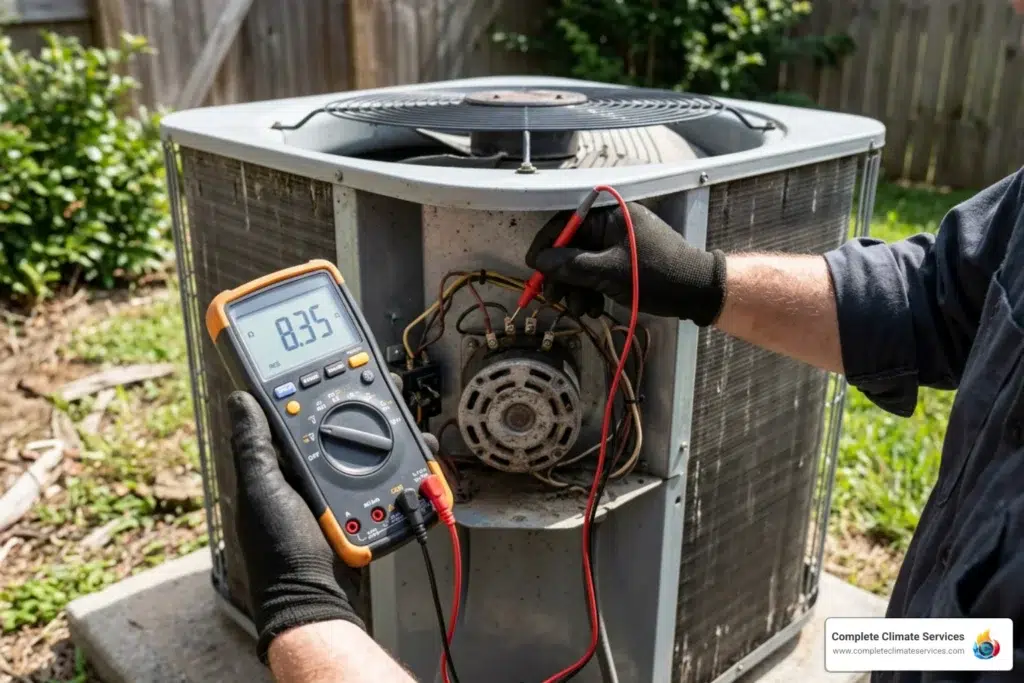
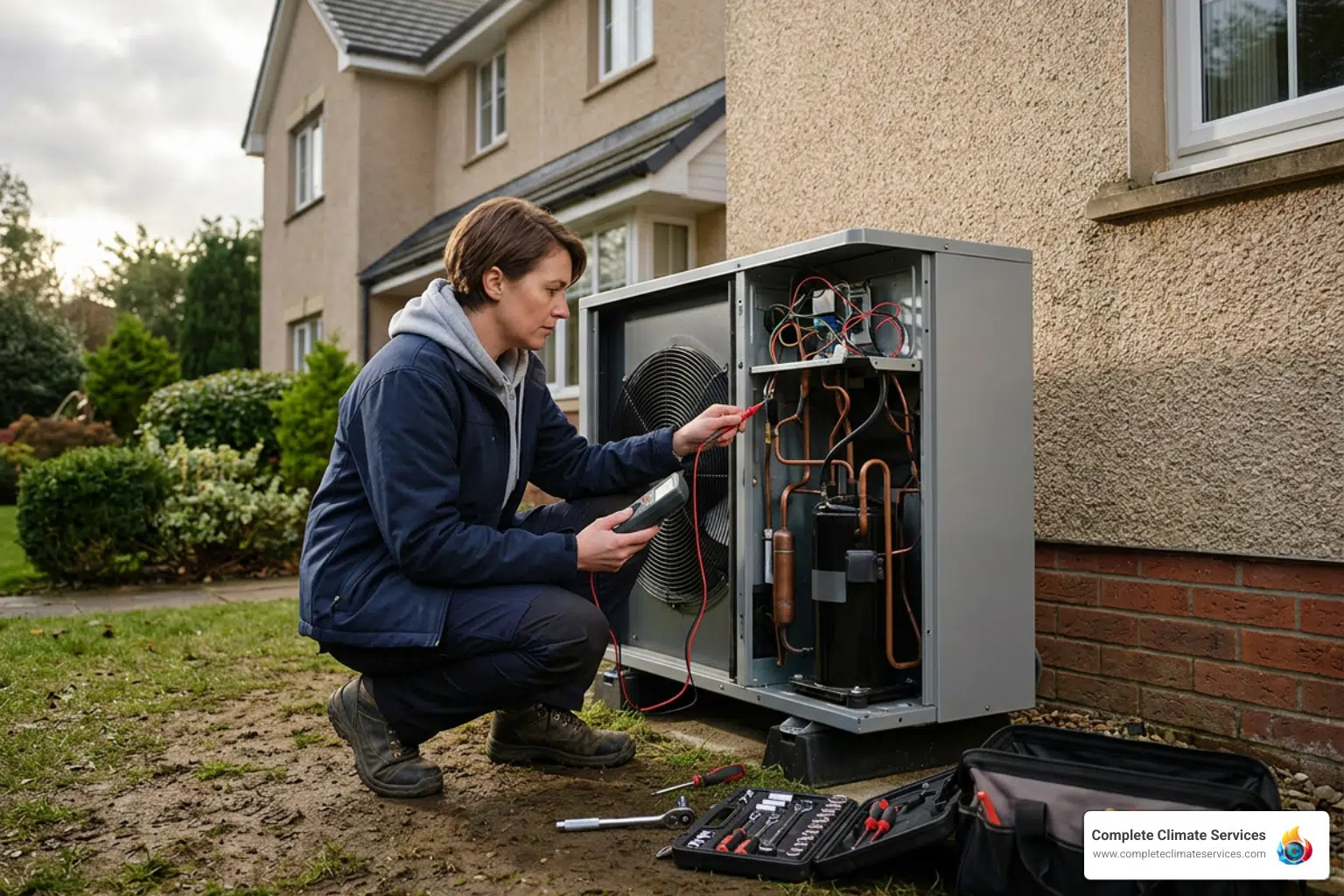
You can also perform a “fan spin test.” If the outdoor fan isn’t moving but the unit is humming, try safely pushing the fan blade with a long stick or screwdriver. If the fan starts spinning and stays spinning, the motor is fine, but the capacitor is dead. For more technical confirmation, an HVAC pro will use a multimeter to check the microfarad (µF) readings to see if they fall within 10% of the rating on the label. Learning about spotting signs of a problem with your compressor can help you distinguish between a simple capacitor fix and a major mechanical failure.
DIY vs. Professional: Costs and Risks
While AC capacitor replacement is a relatively straightforward repair for an expert, it is one of the more dangerous tasks for a homeowner to attempt. Capacitors are designed to store a lethal amount of electricity. Even if you have turned off the power at the breaker, the capacitor itself can still hold a massive charge that can cause severe shock or fire if handled improperly.
If you replace an AC capacitor yourself, the part usually costs about $10 to $75, but you will also need the right tools, including a multimeter, a capacitor discharge tool, and proper personal protective equipment. The bigger issue is safety: capacitor replacement involves high-voltage components, so the risk of electric shock is significant. DIY work can also take 1 to 3 hours once you include research, setup, and testing, and it may even void the manufacturer warranty. With professional service, the capacitor is typically included in the service cost, all tools are supplied by the technician, the job is usually completed in about 30 to 60 minutes, and the work is handled with much lower risk and better warranty protection.
Beyond the physical danger, there are hidden risks of DIY air conditioning repair. If you install the wrong size capacitor or wire it incorrectly, you could burn out your compressor—a repair that costs thousands of dollars compared to a few hundred for a professional capacitor swap.
Cost Breakdown for AC Capacitor Replacement
The total cost for a professional AC capacitor replacement usually includes three main pieces: the service call, the replacement part, and the labor needed to install it and test the system safely. The final price can vary based on the capacitor type, system accessibility, and whether additional electrical issues are found during diagnosis.
The capacitor parts themselves are relatively inexpensive, usually costing between $10 and $75 depending on whether they are single or dual-run units. However, the value of professional service lies in the diagnostic expertise—ensuring that the capacitor was the only problem and that a failing motor didn’t cause the capacitor to blow in the first place. Emergency or after-hours repairs in places like Towson or Columbia may sit at the higher end of that price scale.
Step-by-Step Guide to Safe Replacement
If you are technically inclined and choose to proceed with a DIY fix, safety must be your absolute priority. Follow these steps carefully:
- Shut Off All Power: Turn off the AC at the thermostat, then go to the outdoor “disconnect box” (the metal box on the wall near your unit) and pull the disconnect or flip the switch to “Off.” For extra safety, turn off the AC breaker at your main electrical panel.
- Access the Capacitor: Use a nut driver to remove the side panel of your condenser unit.
- Discharge the Capacitor: This is the most critical step. Even with the power off, the capacitor is “loaded.” Use a certified capacitor discharge tool or a heavily insulated screwdriver to bridge the terminals (touch the metal part of the tool to two terminals at once). You may see a spark—this is normal.
- Document the Wiring: Before removing any wires, take a high-resolution photo. Most dual capacitors have three terminals labeled C (Common), HERM (Hermetic/Compressor), and FAN. You must put the wires back exactly where they came from.
- Swap the Part: Unscrew the mounting bracket, remove the old capacitor, and install the new one. Reconnect the wires according to your photo and the labels on the new part.
Finding the Correct AC Capacitor Replacement
You cannot just buy “any” capacitor. You must match the specifications of your old unit exactly. Look at the label on the side of the old capacitor for two main numbers:
- Microfarads (µF): This might look like “45 + 5 µF.” The first number is for the compressor, and the second is for the fan. This must match exactly.
- Voltage (V): Usually 370V or 440V. You can always use a higher voltage rating (e.g., using a 440V to replace a 370V), but you should never use a lower voltage rating than the original.
- Shape and Size: Capacitors come in “round” or “oval” shapes. Ensure the new one fits in your unit’s mounting bracket.
Frequently Asked Questions
How long does an AC capacitor typically last?
On average, an AC capacitor lasts between 8 and 10 years. However, in high-heat areas or during particularly brutal Baltimore summers, they may fail in as little as 5 years. Frequent “cycling” (the AC turning on and off constantly) and power surges also shorten their lifespan. We recommend a proactive replacement every 5-7 years to avoid a breakdown during peak summer.
Can I run my AC with a bad capacitor?
No. We strongly advise against this. If the capacitor is weak, the motors will run much hotter than they were designed to. This leads to “thermal overload,” where the motor shuts itself off to prevent a fire. Continued use with a failing capacitor can permanently damage the compressor or fan motor, turning a $200 repair into a $3,000 replacement.
What should I do if the AC still won’t start?
If you’ve performed an AC capacitor replacement and the unit still won’t kick on, there are a few other likely culprits. The contactor (the switch that pulls in when the thermostat calls for cooling) might be burnt out, or you might have a blown fuse in the disconnect box. It’s also possible the thermostat itself is malfunctioning.
Conclusion
At Complete Climate Services, we’ve spent over 20 years providing honest, reliable HVAC solutions to our neighbors in Baltimore, Ellicott City, Dundalk, and throughout the surrounding counties. We know that a broken AC is more than just an inconvenience—it’s a safety issue during the peak of summer.
While a DIY AC capacitor replacement might seem like a quick way to save money, the safety risks and potential for system damage are high. Our team of 5.0-star rated technicians can handle the job quickly, safely, and affordably, ensuring your entire system is checked for efficiency and longevity.
Don’t sweat through another humid afternoon. Contact our HVAC specialists and schedule your AC Repair today. Complete Climate Services get your home back to the perfect temperature.