Replace an AC Unit Fan Motor Safely and Correctly
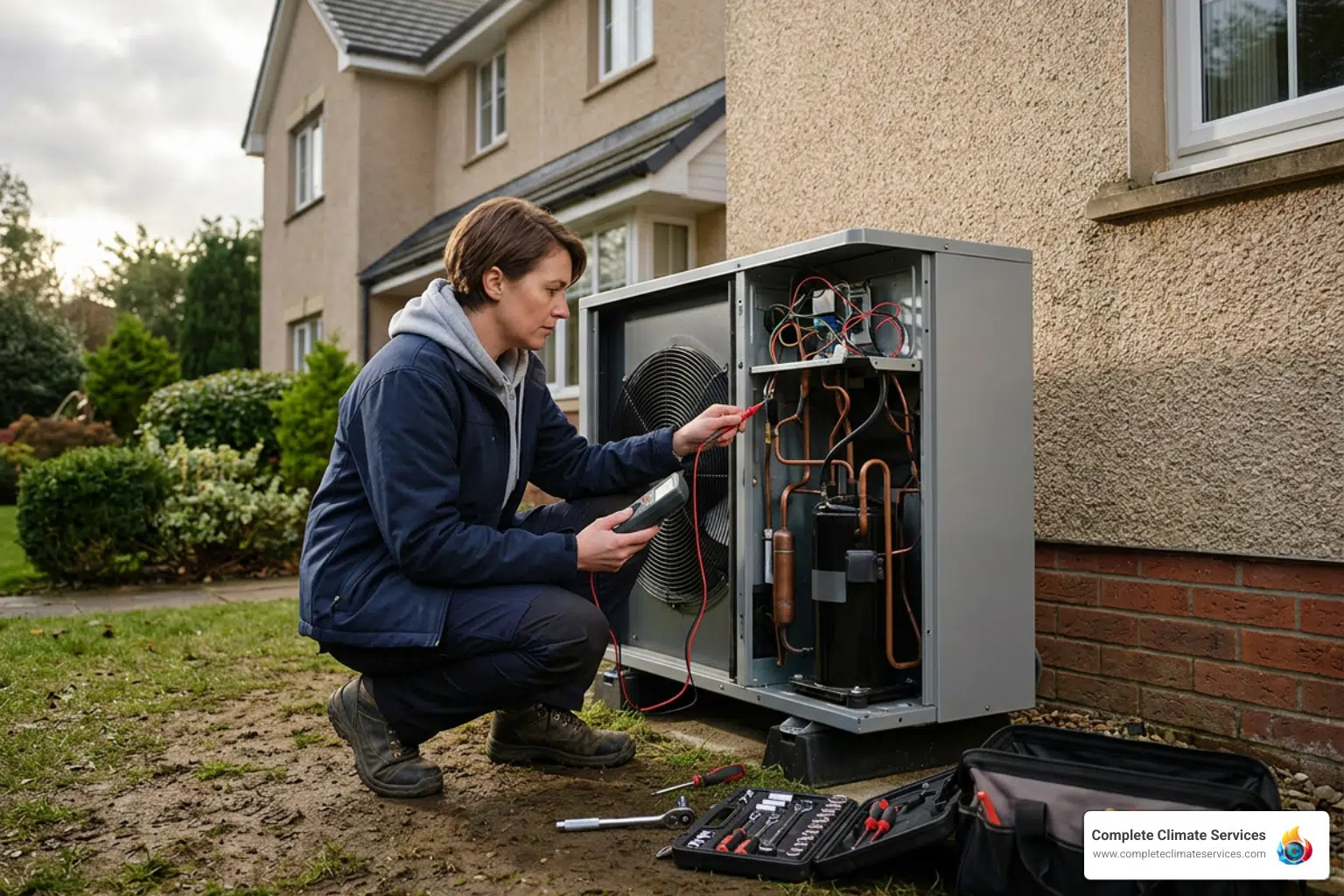
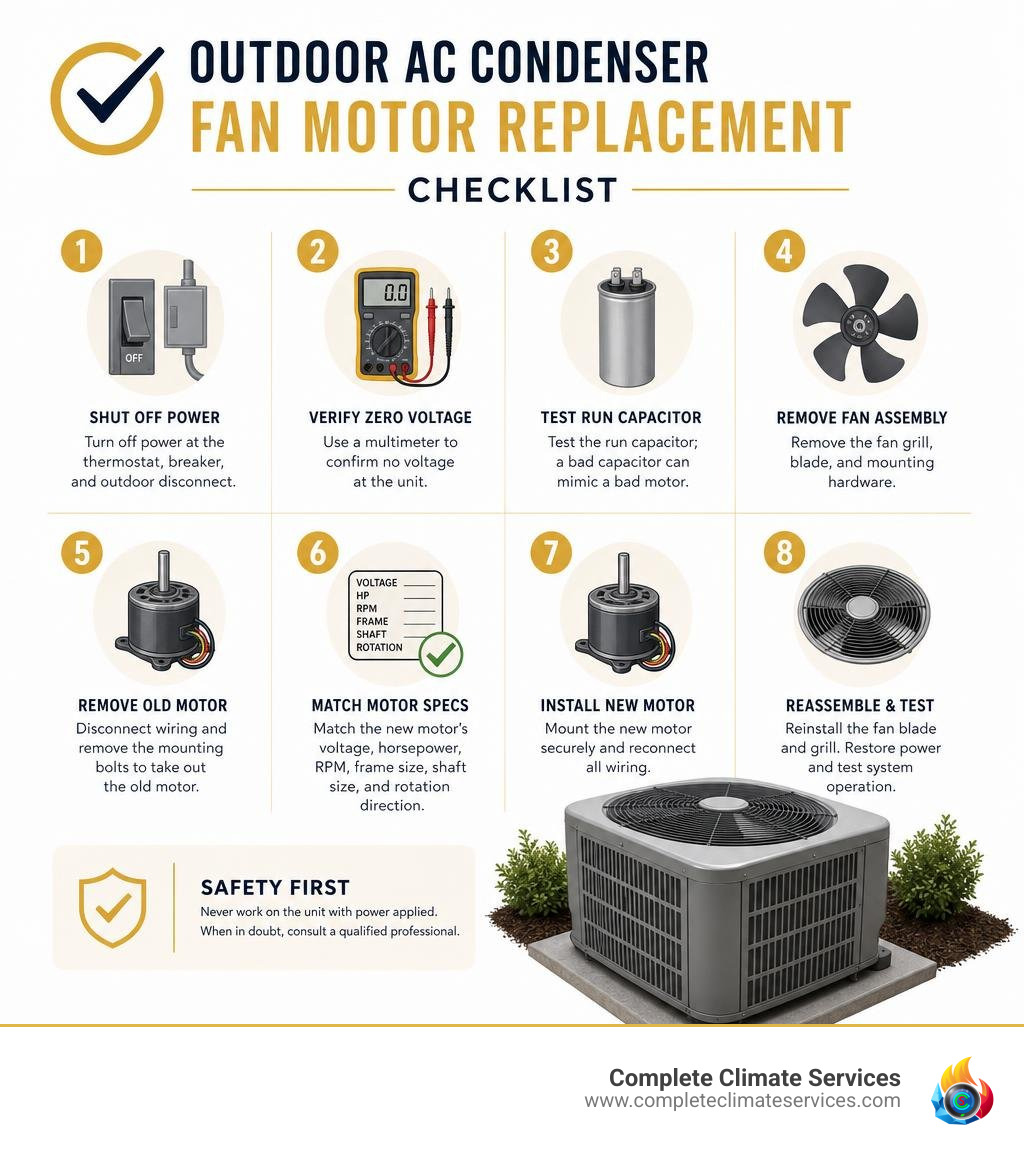
An AC unit fan motor replacement can restore cooling when the outdoor condenser fan will not start, spins slowly, makes grinding noises, or stops during a cooling cycle. Before replacing it, turn off power at the thermostat, breaker, and outdoor disconnect; confirm zero voltage with a multimeter; test the run capacitor; then match the new motor’s voltage, horsepower, RPM, frame size, shaft size, and rotation direction to the old motor’s data plate.
The outdoor fan pulls air through the condenser coil and pushes heat upward. If it fails, shut the system down rather than letting the compressor overheat. A bad capacitor can look like a bad motor, so diagnosing both parts first can prevent an unnecessary repair.
At Complete Climate Services, our HVAC team handles AC unit fan motor replacement and related cooling repairs across the Baltimore area, helping homeowners identify the real failure and restore safe, reliable airflow.
Signs Your Condenser Fan Motor Is Failing
When an outdoor condenser fan motor starts breaking down, it rarely keeps quiet about it. Recognizing the warning signs early saves you from dealing with severe secondary damage to your system. The fan motor is responsible for exhausting heat drawn out of your home; when airflow slows or stops entirely, heat builds up rapidly inside the outdoor condensing unit.
Common symptoms indicating your condenser fan motor is nearing the end of its operational life include:
- Slow or hesitant blade spin: The fan blades struggle to reach full speed, turning sluggishly like a carousel winding down.
- Humming or buzzing noises: The outdoor unit emits a distinct electrical hum while the compressor runs, but the fan blades remain completely stationary.
- Grinding or rattling sounds: Internal motor bearings wear down, lose lubrication, and grind against the housing, creating loud mechanical chatter.
- Intermittent shutdowns: The fan runs for several minutes, gets burning hot to the touch, and suddenly cuts off as its internal thermal overload switch trips to prevent a fire.
- Warm air inside your home: Without active heat dissipation outside, refrigerant cannot condense back into a cool liquid, resulting in lukewarm air blowing from your indoor vents.
- Burning electrical smells: Damaged or shorted copper windings generate intense heat, producing an acrid, burning-plastic odor near the top grille.
If your outdoor fan fails to spin while the system calls for cooling, excessive thermal stress quickly drives up head pressure. That added strain can affect the compressor and other critical cooling components, so scheduling professional AC repair early can help homeowners in Baltimore, Towson, Ellicott City, Columbia, and nearby communities avoid larger system damage.
A failing fan motor can also mimic other AC problems, including capacitor issues, weak airflow, or compressor trouble. If you want to understand related warning signs, our guide to spotting compressor problems explains what to watch for before heat and pressure turn a small repair into a bigger one.
Choosing the Correct Replacement Motor and Capacitor
Selecting a new fan motor involves far more than picking up a generic motor from a shelf. Condenser fan motors must match the exact mechanical and aerodynamic properties engineered into your central air conditioner.
Sourcing the Right AC Unit Fan Motor Replacement
Every outdoor condenser uses a specific motor size engineered to work against the static pressure created by its cabinet design and fan blade pitch. To source the correct unit, carefully record the technical specifications listed on your existing motor’s metal data plate:
- Voltage (VAC): Most residential split systems operate on a single-phase 208-230V line. Always confirm whether your system requires 208-230V or standard 115V power.
- Horsepower (HP): Common ratings include 1/8, 1/6, 1/4, and 1/3 HP. While you can safely install a motor with slightly higher horsepower in an emergency, you must never downgrade to a lower horsepower rating, as an undersized motor will overheat quickly.
- Rotational speed (RPM): Operating speeds are typically 825 RPM or 1075 RPM. Motor speed directly correlates with the physical pole count inside the motor, meaning RPM cannot be changed without compromising airflow and refrigerant subcooling.
- Frame sizing and dimensions: Standard residential units almost universally employ a NEMA 48 or 48Y frame, approximately 5.5 inches in outer diameter, paired with a 0.5-inch diameter output shaft.
- Rotation direction: Look for either clockwise (CW) or counter-clockwise (CCW) rotation facing the lead end (LE) or shaft end (SE). Many modern aftermarket motors feature reversible rotation leads, allowing you to easily switch direction to match your fan blade pitch.
For help weighing OEM cross-references, universal mounting configurations, and capacitor compatibility, our AC fan motor buying guide breaks down what matters before you order a replacement part.
PSC vs ECM vs Shaded Pole Motors
Understanding motor design helps you make sense of wiring diagrams and efficiency choices.
- Shaded pole motors: Inexpensive and simple with very low starting torque and poor electrical efficiency. Rarely found on modern outdoor condensers, they are generally limited to small refrigeration cabinets or exhaust fans.
- Permanent split capacitor (PSC) motors: The long-standing standard for residential air conditioning. PSC motors rely on an external run capacitor to establish an auxiliary magnetic field, delivering continuous torque and solid operating efficiency at a fixed speed.
- Electronically commutated motors (ECM): Brushless DC motors controlled by an onboard microprocessor. ECMs deliver high electrical efficiency and modulate speed smoothly, though they require exact OEM digital programming and dedicated wiring harnesses.
| Motor type | Energy efficiency | Starting torque | Speed control | Common HVAC application |
|---|---|---|---|---|
| Shaded pole | Low, about 20-30% | Very low | Single speed, fixed | Small appliances, small refrigeration |
| PSC, standard | Moderate, about 50-65% | Moderate | Single or dual speed | Standard residential outdoor condensers |
| ECM, high-efficiency | High, about 80-90% | High | Variable or modulating | High-SEER2 split systems and heat pumps |
Step-by-Step AC Unit Fan Motor Replacement Guide

Replacing an outdoor condenser fan motor requires methodical work, steady patience, and strict adherence to electrical safety procedures.
Safety Precautions and Tools Required
Before touching a single screw on the condenser cabinet, you must isolate the equipment from electrical power:
- Switch your indoor thermostat to the Off position.
- Turn off the dedicated air conditioner circuit breaker inside your main electrical service panel.
- Open the outdoor disconnect box mounted on the exterior wall adjacent to your condenser and pull the disconnect block entirely, or flip the disconnect switch off.
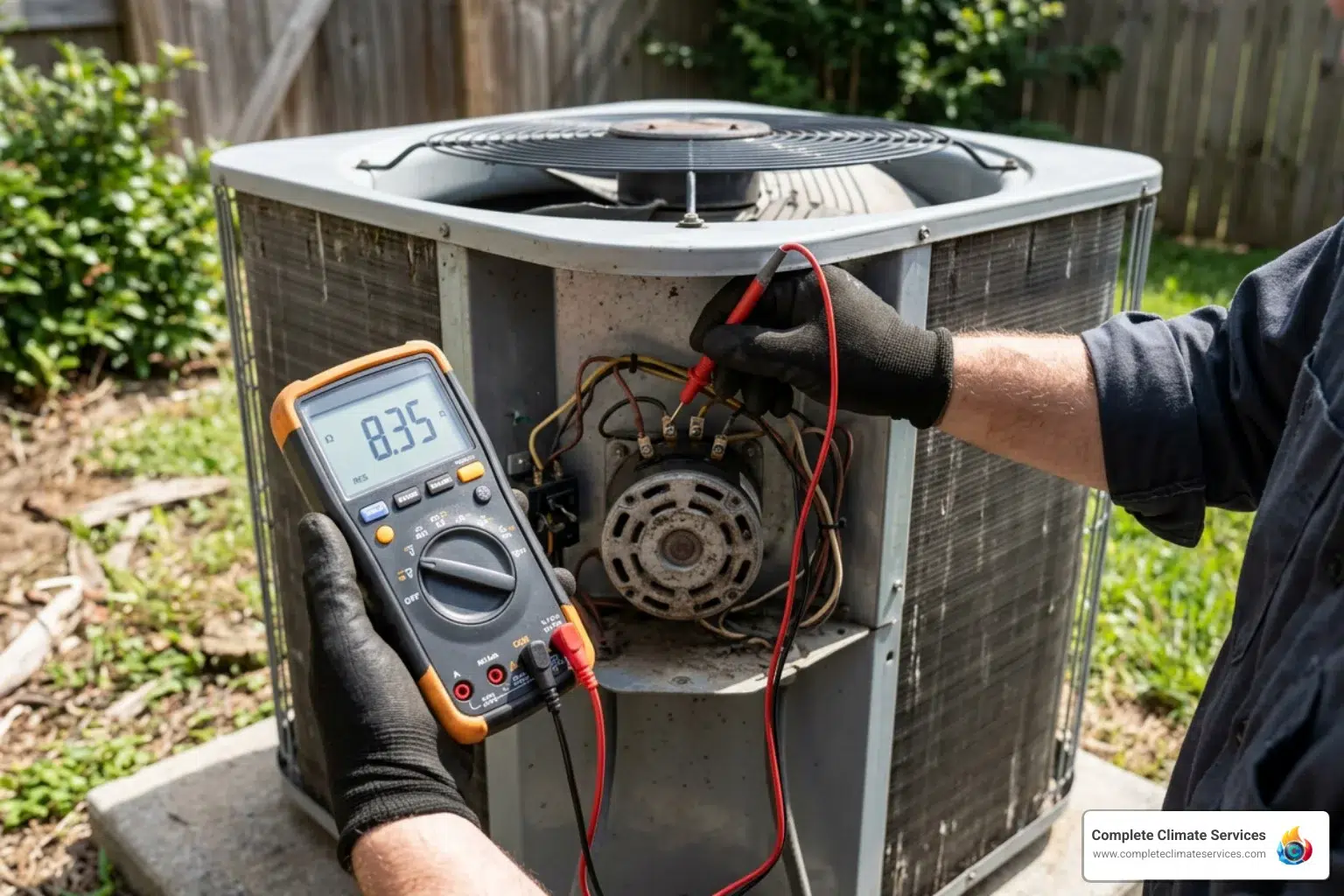
- Remove the condenser electrical service panel cover and use a reliable digital multimeter set to AC volts to test across all incoming contactor line terminals to confirm zero voltage exists.
- Safely discharge the dual run capacitor by bridging an insulated screwdriver across the Common (C) and FAN terminals, and then across Common (C) and HERM. Our AC capacitor replacement guide explains why stored electrical energy makes this step so important.
Essential tools for this repair include:
- Digital multimeter capable of testing AC voltage, capacitance in µF, and resistance in ohms
- 1/4-inch and 5/16-inch nut drivers or magnetic hex sockets
- Adjustable crescent wrenches and open-end box wrenches
- Hub puller tool or sand cloth paired with penetrating lubricant, such as WD-40 or PB Blaster
- Wire strippers, crimpers, and insulated spade terminals
- UV-resistant nylon zip-ties and heat shrink tubing
- Safety glasses and insulated work gloves
Disassembly and Fan Blade Removal
- Document the wiring: Snap clear photos of the capacitor, contactor, and motor wire connections before disconnecting anything.
- Remove top grille: Unfasten the perimeter screws holding the top metal fan grille to the condenser chassis. Lift the assembly upward carefully, watching out for sharp aluminum coil fins and internal copper refrigerant lines.
- Disconnect the old motor: Unclip the wiring harness and thread the wires through the cabinet conduit sleeve into the outdoor compartment.
- Remove the fan blade hub: Loosen the square set screw securing the fan blade hub to the motor output shaft. If corrosion has seized the hub, use sand cloth to clean rust from the exposed shaft, soak the connection in penetrating oil, and gently apply opposing rotational torque or use a dedicated hub puller.
- Prep the new motor: Unbolt the failed motor from the grille bracket. On the replacement motor, pull the lower rubber weep hole drain plugs located on the shaft-facing end so moisture can drain freely, while leaving the top plugs intact to block rain. Slide the rubber rain slinger shield onto the shaft before reinstalling the fan blade.
- Mount and align: Fasten the motor securely to the mounting bracket. Reattach the fan blade, ensuring the set screw seats squarely against the machined flat portion of the shaft.
Wiring and Rotation Configuration
Universal replacement motors typically offer either a 3-wire or 4-wire installation layout:
- 3-wire configuration: The motor’s black power lead connects to the load side, T1 or T2, of the contactor. The yellow or white lead connects to the second contactor load terminal and shares a connection with the Common (C) terminal of the dual run capacitor. The brown lead connects directly to the FAN terminal on the capacitor.
- 4-wire configuration: When using a separate, dedicated oval capacitor for the fan motor, the brown wire goes to one capacitor terminal, the brown-with-white stripe wire goes to the other capacitor terminal, and the black and white line leads go directly across the contactor load terminals.
Fasten all loose wiring away from rotating fan blades using UV-rated nylon zip-ties. Reinstall the top grille, restore power at the disconnect and breaker, and verify that air is pulled inward through the outdoor side coil fins and discharged forcefully straight up through the top.
DIY vs Professional HVAC Service
Undertaking an AC fan motor replacement independently can be a rewarding project, but it requires realistic assessment of your mechanical skills, available diagnostic gear, and comfort around high-voltage electricity.
Estimating Costs for AC Unit Fan Motor Replacement
When planning for an AC unit fan motor replacement, expenses vary depending on whether you purchase parts for a DIY repair or hire a licensed HVAC contractor. Doing the work yourself requires purchasing the motor, matching run capacitor, penetrating lubricant, and potentially specialized tools like a hub puller or digital multimeter.
Professional service encompasses an initial diagnostic trip, electrical testing, guaranteed OEM component matching, full mechanical labor, and workmanship warranty coverage. Additionally, if your central cooling system is still within its manufacturer warranty period, the replacement motor part itself may be covered, leaving you responsible only for standard technician labor.
The Risks of DIY Electrical Repair
While performing repairs yourself eliminates labor fees, working on 240-volt outdoor electrical equipment carries real safety and financial risks. High-voltage capacitors store electrical charges long after the breaker is switched off. Incorrect wire routing can cause immediate short circuits that damage the system’s electronic control board or burn out the compressor.
Improper fan blade alignment or warping the aluminum blades with pry bars introduces balance vibrations that destroy new motor bearings within months. For Baltimore-area homeowners who want help with diagnostics, safe part matching, or urgent cooling issues, Complete Climate Services provides AC services for repair and system support without asking you to troubleshoot high-voltage equipment alone.
Uncertified repairs can also void remaining manufacturer warranties or leave hidden problems unresolved. If you want a clearer sense of where DIY work becomes risky, our article on the risks of DIY air conditioning repair explains the electrical and equipment issues that make professional help the safer choice.
Frequently Asked Questions About AC Fan Motors
Why should I replace the capacitor at the same time as the fan motor?
Run capacitors degrade over time due to high ambient temperatures and electrical cycling. Even if an old capacitor appears functional, its capacitance rating in microfarads (µF) often drifts outside the acceptable 10% operating tolerance. Operating a brand-new motor on an aged, weak capacitor reduces startup torque, causing internal copper windings to run excessively hot and leading to premature motor failure within weeks or months.
Can I replace an 825 RPM motor with a 1075 RPM motor?
No. You should never alter motor RPM. An 825 RPM motor is built with an 8-pole stator, whereas a 1075 RPM motor operates using a 6-pole stator. Forcing an 825 RPM fan blade to spin at 1075 RPM overloads the motor windings, generates excessive noise, pulls elevated amperage, and upsets the engineered balance between airflow and system head pressure.
How do I wire a new condenser fan motor if the wire colors do not match?
Never rely solely on wire color conventions from an old motor, as aftermarket manufacturers use different labeling standards. Always refer to the wiring schematic diagram printed directly on the housing decal of your new motor. Identify the line power lead, the start winding capacitor lead, and the common lead based on the manufacturer’s connection chart.
Conclusion
A smoothly operating outdoor fan motor is vital for maintaining home comfort and protecting your compressor from damaging thermal stress during peak summer heat. By matching exact specifications, including horsepower, RPM, frame size, voltage, and rotation direction, you can restore proper heat dissipation and system efficiency.
Whether you need diagnostic assistance, emergency repair, or regular seasonal tune-ups, Complete Climate Services brings over two decades of experience and 5.0-star customer satisfaction to homeowners throughout Baltimore City, Baltimore County, Anne Arundel County, and Howard County. If your outdoor fan motor is failing, contact our professional AC repair technicians and keep your cooling equipment running reliably all season long.