

When Your Heat Goes Out: What Every Baltimore Homeowner Should Know About Hiring a Furnace Repair Technician
A furnace repair technician is a licensed professional who diagnoses, fixes, and maintains heating systems — and knowing what they do (and when to call one) can save you time, money, and a very cold night.
Here’s a quick overview of what a furnace repair technician does:
| What They Do | Why It Matters |
|---|---|
| Diagnose heating problems | Finds the root cause fast |
| Repair or replace faulty parts | Restores heat safely |
| Inspect heat exchangers and gas lines | Prevents carbon monoxide risk |
| Test system performance | Confirms the repair worked |
| Advise on repair vs. replacement | Saves money long-term |
Your furnace is one of those appliances you barely think about — until it stops working on a January morning and the temperature inside starts dropping. At that point, one question takes over: who do I call, and can I trust them?
That’s exactly what this guide answers.
I’m Michael Holcomb, Co-Founder and Operations Manager of Complete Climate Services, and I’ve spent years helping Baltimore homeowners navigate furnace breakdowns, understand their repair options, and find the right furnace repair technician for the job. Let’s walk through everything you need to know.
What Does a Professional Furnace Repair Technician Do?
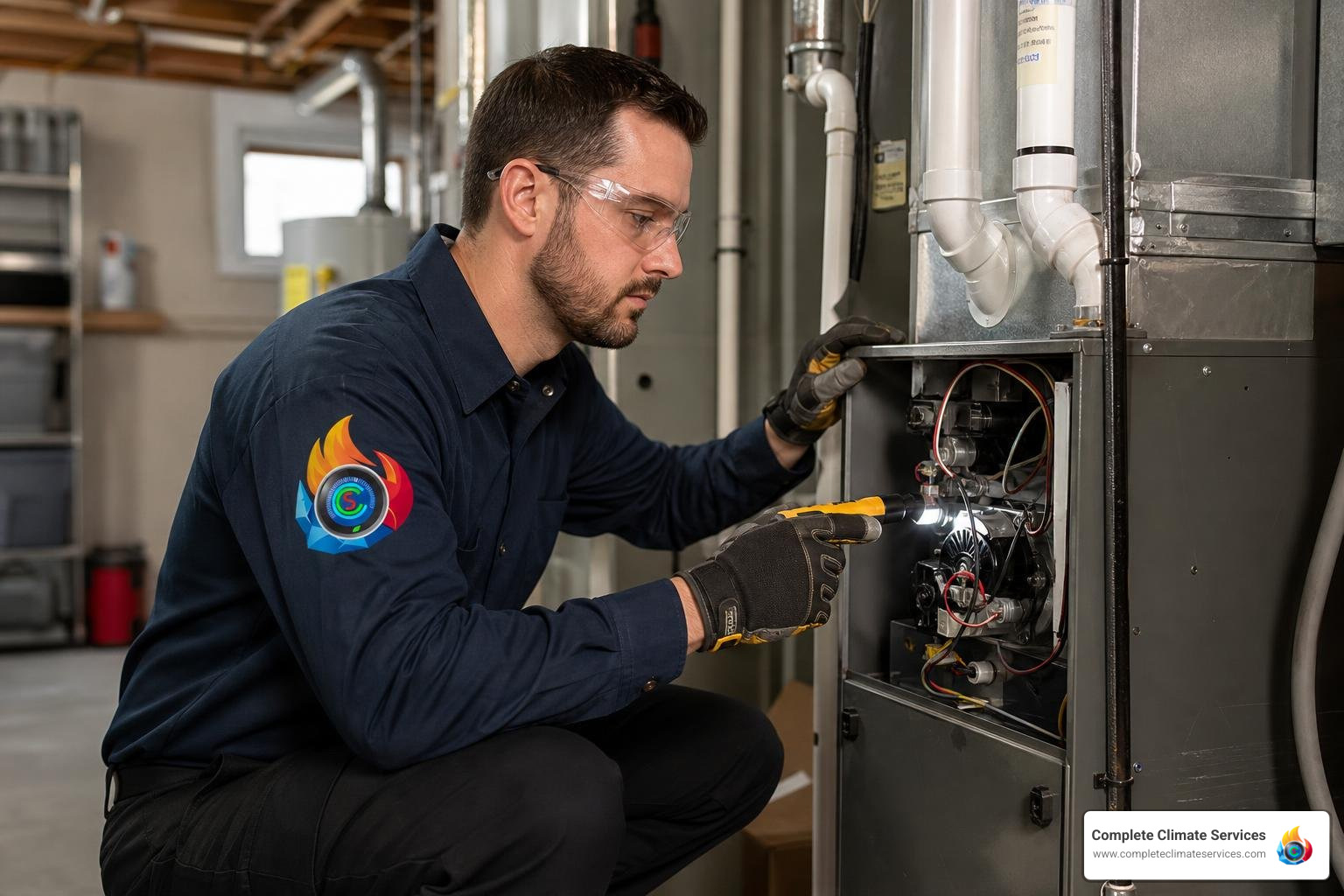
When your heating system fails, you aren’t just paying for someone to turn a wrench. You are hiring a highly trained specialist who understands thermodynamics, electrical circuitry, airflow dynamics, and combustion safety. A professional furnace repair technician is responsible for keeping your home warm and, more importantly, keeping your family safe.
On any given day, our technicians handle everything from minor component swaps to complex electrical troubleshooting. We analyze system controls, calibrate thermostats, inspect vent pipes, and evaluate airflow to ensure that heat is distributed evenly throughout your home. For a complete look at what we do to keep local heating systems running smoothly, explore our furnace services.
The Anatomy of a Typical Service Call
When a furnace repair technician arrives at your home, they follow a structured diagnostic process to identify and resolve the issue. Here is what you can expect during a standard service call:
- Initial Consultation: The technician will ask you about the symptoms you’ve noticed, such as strange noises, cold spots, or a sudden spike in your utility bills.
- Visual & Operational Inspection: We check the thermostat settings, verify the power supply, and look for obvious physical issues like a clogged air filter or a flickering pilot light.
- Reading Error Codes: Modern furnaces have control boards that flash LED light sequences representing specific error codes. Technicians use these codes to pinpoint the exact failure point.
- Electrical and Component Testing: Using a multimeter, the technician tests the voltage and continuity of key parts like the ignitor, limit switches, and flame sensor.
- Clear Communication: Before any tools are used for repairs, the technician should explain the diagnosis clearly and provide a transparent, upfront estimate.
Crucial Safety Checks Performed by a Furnace Repair Technician
Safety is the single most important aspect of a technician’s job. Because gas furnaces rely on combustion to produce heat, a malfunction can lead to gas leaks or carbon monoxide (CO) poisoning.
During every single repair visit, a professional technician will perform these non-negotiable safety checks:
- Carbon Monoxide Testing: We use specialized electronic detectors to measure CO levels in the air stream and around the unit.
- Heat Exchanger Inspection: We check the metal heat exchanger for microscopic cracks. A cracked heat exchanger can allow toxic combustion gases to mix directly with the air blowing into your living spaces.
- Gas Leak Detection: We apply specialized solutions or use electronic “sniffers” along gas lines and valves to verify there are no fuel leaks.
- Safety Switch Testing: We test the limit switches and rollout switches to ensure the furnace will automatically shut down if it overheats or if flames roll out of the burner area.
Ignoring these issues can have severe consequences.
Common Furnace Problems That Require Professional Attention

Furnaces are complex machines, and like any mechanical system, they wear out over time. While some minor issues can be solved by a quick homeowner check, most problems require the specialized tools and training of a professional. If you want to keep an eye out for early warning signs, refer to our guide on common furnace problems.
Here are the most common issues that require a technician’s expertise:
Ignition and Flame Sensor Failures
If your furnace turns on but blows cold air, or if it starts up and immediately shuts back down, you are likely dealing with an ignition or flame sensor failure.
In older systems, the pilot light may simply go out due to a draft or a failing thermocouple. In modern systems, electronic ignitors can crack or burn out over time. Additionally, the flame sensor—a small metal rod that detects whether a flame is present—can accumulate carbon buildup. If the sensor is dirty, it won’t detect the flame and will shut off the gas valve as a safety precaution.
For a deeper dive into these issues, see our guide to ignition failure.
Cracked Heat Exchangers and Gas Valve Issues
A cracked heat exchanger is one of the most serious diagnoses a furnace repair technician can make. It typically occurs in older systems due to the constant expansion and contraction of the metal over years of heating cycles. If a crack is found, the furnace must be shut down immediately to prevent carbon monoxide from entering your home.
Gas valves can also fail or become stuck, preventing fuel from reaching the burners. Because handling gas lines carries significant safety risks, these repairs must always be handled by licensed professionals.
How Long Does a Typical Repair Take?
Repair time depends on the issue, the condition of the system, and whether the required part is available. After diagnosing the problem, a qualified technician should explain the expected work, whether the repair can be completed during the visit, and whether a follow-up appointment is needed.
Repair vs. Replace: Making the Right Decision for Your Home
One of the toughest decisions a homeowner has to make is whether to keep repairing an aging furnace or invest in a brand-new system. While a new installation has a higher upfront cost, it can reduce future repair needs and improve efficiency over time. If you decide a new system is the best route, we can help guide you through the process of furnace installation.
When to Call a Furnace Repair Technician for a Fix
You should generally opt for a repair if:
- Your furnace is under 10 years old and may still be covered by a manufacturer’s parts warranty.
- The repair cost is small compared with a new system.
- Your heating bills have remained stable and the system still heats your home evenly.
When It’s Time for a Full System Replacement
It is usually time to replace your system if:
- The system is over 15 to 20 years old: Even a well-maintained furnace will begin to lose efficiency and reliability after 15 years.
- You experience frequent breakdowns: If you are calling a technician multiple times a winter, those repair bills add up fast.
- Your heating bills are skyrocketing: An old, inefficient furnace has to work much harder to keep your home warm, consuming more energy.
- The heat exchanger is cracked: Because of the safety risks and the scope of the repair, a cracked heat exchanger in an older unit often warrants full system replacement.
How Homeowners Can Prepare, Prevent, and Verify Qualifications
Before you hire a furnace repair technician, it is important to verify their credentials. Ensuring your technician is licensed and fully insured protects both them and your property.
In Maryland, a professional technician should hold a valid Journeyman or Master HVAC license. Additionally, they should have EPA Section 608 Certification (required for handling refrigerants) and ideally hold certifications from national organizations like NATE (North American Technician Excellence).
Simple Steps to Prepare for Your Technician’s Visit
You can help your service call go smoothly and quickly by taking a few simple preparatory steps:
- Clear the Area: Ensure there is at least three feet of clear space around your furnace so the technician has safe, easy access to the unit.
- Check the Thermostat: Make sure your thermostat has fresh batteries and is set to “Heat.”
- Secure Your Pets: Keep your pets in a separate room so they don’t get startled by the technician or slip out of open doors.
- Clear a Path: Make sure hallways, basements, and utility closets are clear of clutter.
Ongoing Maintenance to Extend Your Furnace’s Lifespan
The best way to avoid emergency repairs is to invest in regular preventative maintenance. Changing your air filters every 1 to 3 months is the easiest and most effective task you can perform yourself. A dirty, clogged filter restricts airflow, which forces your furnace to work harder, overheats the heat exchanger, and can cause the system to short-cycle and shut down entirely.
Additionally, scheduling an annual professional tune-up before the winter season begins ensures that all electrical connections are tight, burners are clean, and safety controls are operating perfectly. Regular maintenance can help reduce unexpected breakdowns and support reliable system performance.
Frequently Asked Questions About Furnace Repairs
What are the most common signs that my furnace needs immediate repair?
You should call a furnace repair technician immediately if you notice:
- Unusual Noises: Banging, squealing, rattling, or whistling sounds coming from the cabinet.
- A Yellow Pilot Flame: A healthy gas burner should burn a steady blue. A yellow or flickering flame indicates incomplete combustion, which can produce carbon monoxide.
- Weak Airflow or Cold Air: The system runs, but the air coming from your vents is weak or cool.
- Frequent Cycling: The furnace turns on and off rapidly without reaching your thermostat’s set temperature.
Is furnace repair covered by standard homeowners insurance?
Generally, standard homeowners insurance does not cover repairs caused by normal wear and tear or lack of maintenance. However, if your furnace is damaged by a covered peril—such as a fire, a severe storm, or a sudden water pipe burst—your policy may help cover the cost of repair or replacement. Always check with your insurance agent and keep thorough maintenance records to support any potential claims.
How often should I schedule professional furnace maintenance?
We recommend scheduling a professional inspection and tune-up once a year, ideally in the early autumn before you turn your heating system on for the first time. This ensures your system is clean, safe, and ready to handle the freezing winter temperatures. Learn more about the benefits of a fall inspection.
Conclusion
A reliable, safe heating system is essential for your comfort and peace of mind during the cold Maryland winter. While furnace breakdowns are always inconvenient, knowing how to recognize warning signs, what to expect during a service call, and how to choose a qualified professional makes the process much less stressful.
At Complete Climate Services, we are proud to serve families across Baltimore, Catonsville, Columbia, Ellicott City, Dundalk, Towson, and the surrounding areas. With 20+ years of HVAC experience and 5.0 stars on Google, our team of licensed technicians is always here to help.
Don’t wait in the cold—schedule your furnace repair with Complete Climate Services today to keep your home warm, safe, and comfortable all winter long.
Complete Climate Services LLC · 204 S Chapel St, Baltimore, MD 21231 · (443) 898-4747.

