

What Your Inverter Heat Pump Installation HSPF Rating Tells You
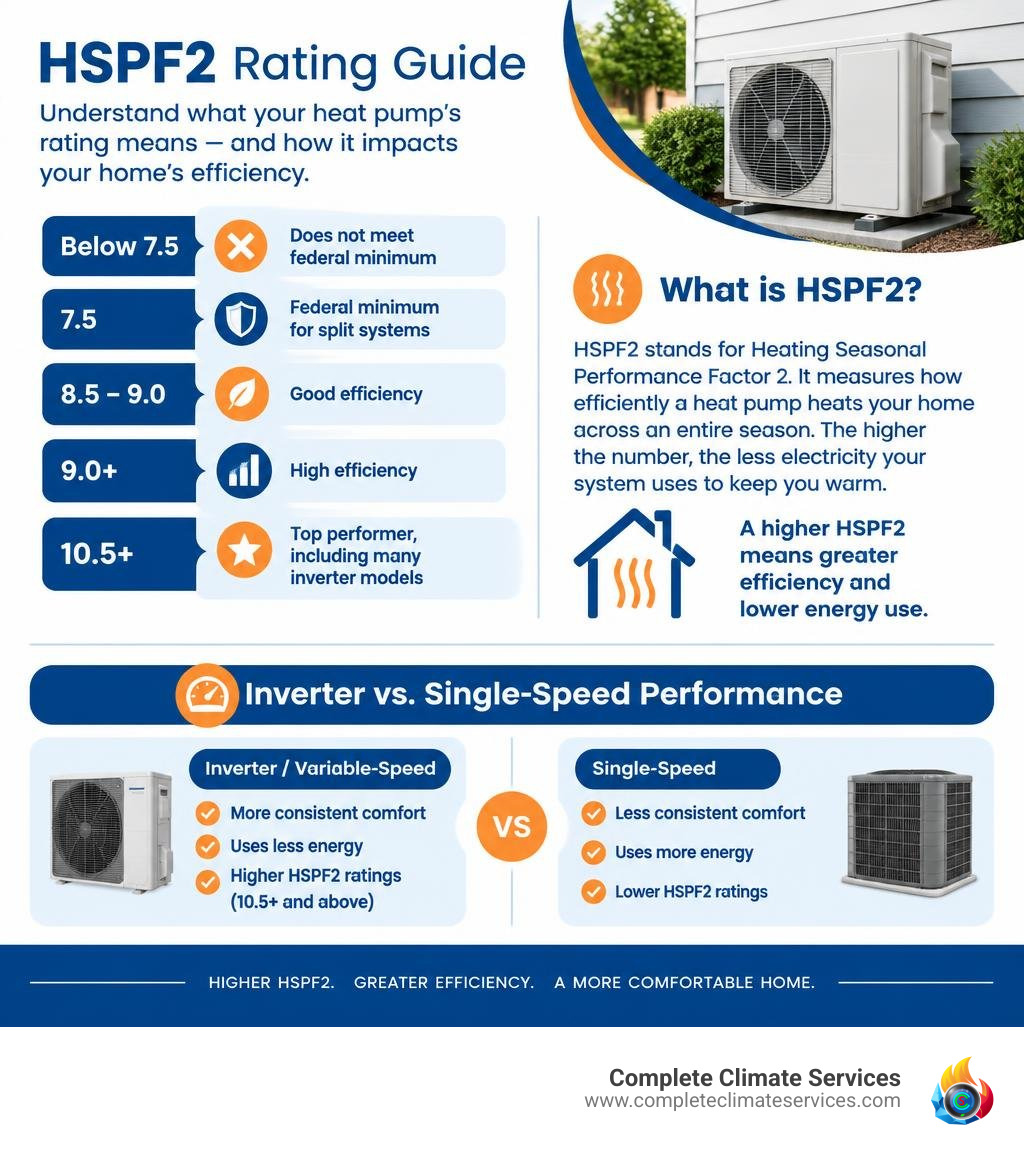
Your inverter heat pump installation HSPF rating helps explain how efficiently the system can heat your home across the season. Here’s a quick-reference breakdown:
| HSPF2 Rating | What It Means |
|---|---|
| Below 7.5 | Does not meet federal minimum |
| 7.5 | Federal minimum for split systems |
| 8.5 – 9.0 | Good efficiency |
| 9.0+ | High efficiency |
| 10.5+ | Top performer, including many inverter models |
HSPF2 stands for Heating Seasonal Performance Factor 2. It measures how efficiently a heat pump heats your home across an entire season. The higher the number, the less electricity your system uses to keep you warm.
A few things to know upfront:
- The Department of Energy requires a minimum HSPF2 of 7.5 for new split-system heat pumps (as of 2023).
- Inverter (variable-speed) heat pumps consistently outperform single-speed models, with top units reaching 10.5 HSPF2 or higher.
- Heat pumps move heat rather than generate it, which can make them an efficient heating option.
For Baltimore homeowners comparing heat pump services, choosing the right HSPF2 rating could mean the difference between a manageable energy bill and a painful one.
I’m Michael Holcomb, Co-Founder and Operations Manager of Complete Climate Services, and I’ve spent years helping Baltimore homeowners choose efficient inverter heat pump systems to maximize comfort and minimize operating costs. Let me walk you through everything you need to know to make a confident, informed choice.
Understanding HSPF2 and How Inverter Technology Drives Efficiency
When you are shopping for a new heating and cooling system, the alphabet soup of industry terms can feel overwhelming. You will see SEER2, EER2, COP, HSPF, and now HSPF2.
For Maryland homeowners, heating efficiency is a major driver of winter utility bills. For Maryland homeowners, HSPF rating is a critical efficiency benchmark when planning an inverter heat pump installation.
To help you get a clear view of how these standards have evolved, let us look at how the older HSPF metrics compare to the modern HSPF2 requirements.
Comparing HSPF vs. HSPF2 Standards
| System Type | Old Rating Standard (HSPF) | New Rating Standard (HSPF2) | Testing Static Pressure Increase |
|---|---|---|---|
| Split System Heat Pumps | Minimum 8.8 HSPF | Minimum 7.5 HSPF2 | From 0.1 to 0.5 in. wg |
| Single-Packaged Heat Pumps | Minimum 8.0 HSPF | Minimum 6.7 HSPF2 | From 0.1 to 0.5 in. wg |
To make sure you get the absolute most out of your system, you can explore mini-split efficiency and ductless mini splits to see how different configurations affect these numbers.
What is HSPF2 and How Does It Differ From HSPF?
HSPF stands for Heating Seasonal Performance Factor. It represents the total heating output of a heat pump during its normal annual usage period for heating (measured in British Thermal Units, or BTUs) divided by the total electric energy input (measured in watt-hours) during the same period.
Think of it like the highway miles-per-gallon (MPG) rating for your car, but specifically for your home’s heating system.
On January 1, 2023, the Department of Energy (DOE) officially implemented the HSPF2 rating system. The “2” indicates that the equipment was tested under the new M1 blower testing standards.
Under the old testing system, manufacturers evaluated heat pumps in laboratory conditions that assumed very low resistance to airflow (static pressure) inside the ductwork, specifically at 0.1 inches of water gauge (in. wg).
In the real world, however, home ductwork is rarely perfect. It has bends, dust, registers, and filters that restrict airflow. The new HSPF2 standard forces manufacturers to test systems at 0.5 in. wg, which is five times the static pressure of the old test.
Because the testing conditions are much tougher and closer to real-world scenarios, the numerical ratings for HSPF2 look lower than older HSPF ratings (for example, an old 8.8 HSPF rating converts roughly to a 7.5 HSPF2), even though the physical equipment is just as efficient, if not more so.
Federal Minimum HSPF2 Requirements
Under the current federal standards, all newly manufactured residential split-system heat pumps must meet a minimum HSPF2 rating of 7.5. For single-packaged systems (where the compressor and air handler are housed in one outdoor cabinet), the minimum is 6.7.
BGE EmPOWER Maryland may offer rebates for qualifying equipment; we can help check eligibility.
How Inverter Compressors Achieve Higher Ratings
Traditional heat pumps use single-stage compressors. These systems operate like a light switch: they are either fully on or completely off. When your thermostat calls for heat, the system blasts on at full capacity, warms the house quickly, and shuts off. This constant cycling consumes massive amounts of energy and causes noticeable temperature swings.
Inverter heat pumps, also known as variable-speed heat pumps, work more like a dimmer switch. The inverter technology modulates the compressor’s speed up or down in tiny increments, across a wide range of operating capacity.
Instead of shutting off, the system runs continuously at a very low, whisper-quiet speed to maintain a perfectly steady indoor temperature within half a degree of your thermostat setting.
Because an inverter system spends the vast majority of its time operating at lower speeds (part-load capacity), it operates at peak thermodynamic efficiency. It does not have to overcome the high electrical startup currents that single-stage systems face multiple times an hour.
This exceptional part-load efficiency is exactly how inverter models easily achieve HSPF2 ratings above 9.0, with premium models climbing as high as 10.5 or 11.0.
If you want to dive deeper into the mechanics of this technology, you can how inverter heat pumps differ from traditional, single-stage systems.
What Affects Real-World HSPF2 Performance
Buying a system with a high laboratory-certified HSPF2 rating is only half the battle. If the installation is done poorly, your real-world efficiency will plunge.
In our 20+ years servicing Baltimore County, Howard County, and Anne Arundel County, we have seen brand-new, high-end systems perform worse than basic models because of poor installation choices.
To get a complete view of how to size and design these systems for cold weather, you can read the DOE sizing guide published by the Department of Energy.
Why Oversizing Hurts Inverter Heat Pump Efficiency
One of the most common mistakes in our industry is oversizing. Some contractors assume that “bigger is always better” when it comes to heating. With variable-speed inverter systems, this assumption is completely wrong.
Every inverter heat pump has a specific “turn-down ratio,” which is the lowest speed at which the compressor can run stably. If a technician installs a system that is too large for your home’s actual heating load, even its lowest operating speed will produce too much heat for the space.
This forces the smart, expensive inverter system to cycle on and off constantly, just like a cheap, single-stage unit.
This frequent on-and-off cycling (known as short-cycling) destroys the system’s seasonal efficiency, spikes your electric bills, and prevents the heat pump from properly dehumidifying your home during the humid Baltimore summers.
To prevent this, we size every system to your home’s actual heating and cooling needs.
Balancing SEER2 and HSPF2 in Cold Climates
While HSPF2 measures heating efficiency, SEER2 (Seasonal Energy Efficiency Ratio 2) measures cooling efficiency. Homeowners often ask us which rating they should prioritize.
The answer depends entirely on your local climate zone. In the mid-Atlantic region (including Baltimore, Dundalk, and Columbia), we experience a true mix of hot, humid summers and moderately cold winters. Because our heating season is longer and more energy-intensive than our cooling season, HSPF2 should be your primary focus.
When evaluating cold-climate performance, look for these specific factors:
- Inverter-Driven Cold Climate Heat Pumps (CCHPs): These systems are engineered to maintain strong heating capacity down to 5°F and continue extracting heat from the outdoor air at temperatures as low as -22°F.
- Turn-Down Ratio: Ensure the system can scale down to low capacities during mild spring and autumn days to prevent short-cycling.
- Dual-Fuel Compatibility: In older, poorly insulated homes, a high-HSPF2 heat pump paired with an existing gas furnace in a dual fuel system lets the furnace operate only during extreme sub-freezing spikes, optimizing your energy costs.
Best Practices for a High-Performance Inverter Heat Pump Installation
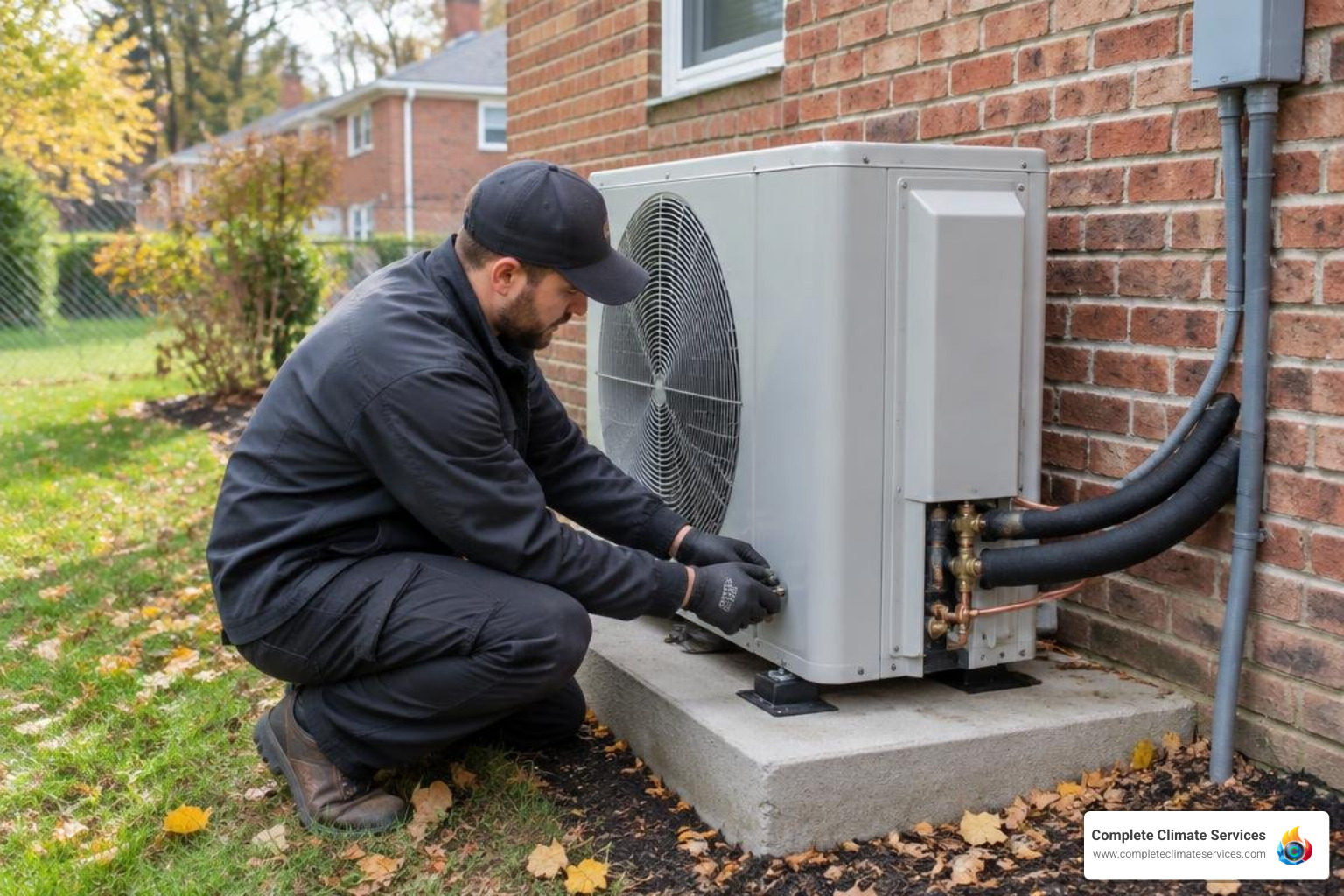
Installing an inverter heat pump is a highly technical process that requires specialized tools and strict adherence to mechanical physics.
Installation shortcuts can compromise efficiency, reliability, and long-term performance.
For a solid foundation on what to look for during this process, you can read our heat pump installation tips.
Installation Steps That Protect Your HSPF2 Performance
A quality installation usually includes steps like these:
- Nitrogen Purging During Brazing: Dry nitrogen should flow through refrigerant lines during brazing to limit oxidation and help protect sensitive components from copper oxide scale.
- Proper Evacuation: Before refrigerant is released into the lines, the system should be evacuated thoroughly to remove air and moisture. Leftover moisture can react with system oil and contribute to damaging acids.
- Refrigerant Line Sizing and Insulation: Refrigerant lines should be sized correctly and insulated with quality closed-cell material to limit capacity loss. The liquid and vapor lines should also be kept apart to prevent unwanted heat transfer.
- A2L Refrigerant Handling: A2L refrigerants such as R-454B require appropriate recovery equipment, leak detection, and installation practices because they are classified as mildly flammable.
For those who want to see the exact manufacturer-level specifications for these modern A2L systems, consult the installation documentation provided for the split-system unit being installed.
Maintaining Your Inverter Heat Pump After Installation
Routine maintenance helps an inverter heat pump operate reliably and maintain consistent comfort after installation. Schedule professional service once a year, ideally in the fall before the heating season, so a technician can inspect the system, clean key components, and address developing issues. Between visits, keep the outdoor unit clear of leaves, snow, grass clippings, and other debris that can restrict airflow. Check the area around the unit after storms and avoid piling snow against it. Replace or clean your air filter on the schedule recommended for your system, since a clogged filter can reduce airflow and strain equipment. If you notice heavy ice on the outdoor unit that does not clear after a normal defrost cycle, contact a qualified HVAC technician rather than trying to chip it away yourself.
Frequently Asked Questions About Inverter Heat Pumps
What is a good HSPF2 rating for an inverter heat pump?
A good HSPF2 rating for an inverter heat pump is 8.5 or higher. Premium, high-efficiency inverter models typically achieve HSPF2 ratings between 9.5 and 10.5.
Do heat pumps lose efficiency in extreme cold?
Yes, all air-source heat pumps lose some efficiency as the outdoor temperature drops because there is less heat energy available in the freezing air to extract.
However, modern cold-climate inverter heat pumps are vastly superior to older models. While standard heat pumps begin to struggle and rely on expensive electric backup “heat strips” around 30°F, advanced inverter systems can retain strong heating output down to 5°F and operate efficiently down to -22°F.
How much can a high-HSPF2 heat pump save on energy bills?
Savings depend on your current system, your home’s insulation, and local utility rates.
Is an inverter heat pump worth it in Maryland?
For many Maryland homeowners, an inverter heat pump is worth considering because it can provide steady comfort through humid summers and cold winters. The right choice depends on the home’s insulation, ductwork, electrical setup, and heating needs.
How long does an inverter heat pump installation take?
Most homes can be completed in one to two days, depending on the ductwork and electrical work involved. More complex replacements or system changes may require additional time to complete safely and correctly.
Conclusion
Investing in a high-efficiency inverter heat pump is one of the smartest upgrades you can make for your home. By choosing a system with a strong HSPF2 rating and ensuring it is installed by licensed, experienced professionals, you will enjoy lower energy bills, whisper-quiet operation, and unmatched indoor comfort all year round.
Written by Michael Holcomb, Co-Founder and Operations Manager, Complete Climate Services.
At Complete Climate Services, we bring 20+ years of HVAC experience to homeowners and businesses in Baltimore City, Baltimore County, Anne Arundel County, and Howard County. We have 5.0 stars on Google, reflecting our commitment to honest, reliable service without cutting corners.
When you are ready to upgrade your home’s comfort and efficiency, schedule an inverter heat pump installation with us and ask how the inverter heat pump installation HSPF rating affects system selection. Our team will look at your home and current system, explain your options, and help you choose an inverter heat pump that fits your comfort needs. To get started, contact our team.
Complete Climate Services LLC · 204 S Chapel St, Baltimore, MD 21231 · (443) 898-4747

