

How a Dual Fuel Heat Pump Works (And Why It Matters for Your Energy Bills)
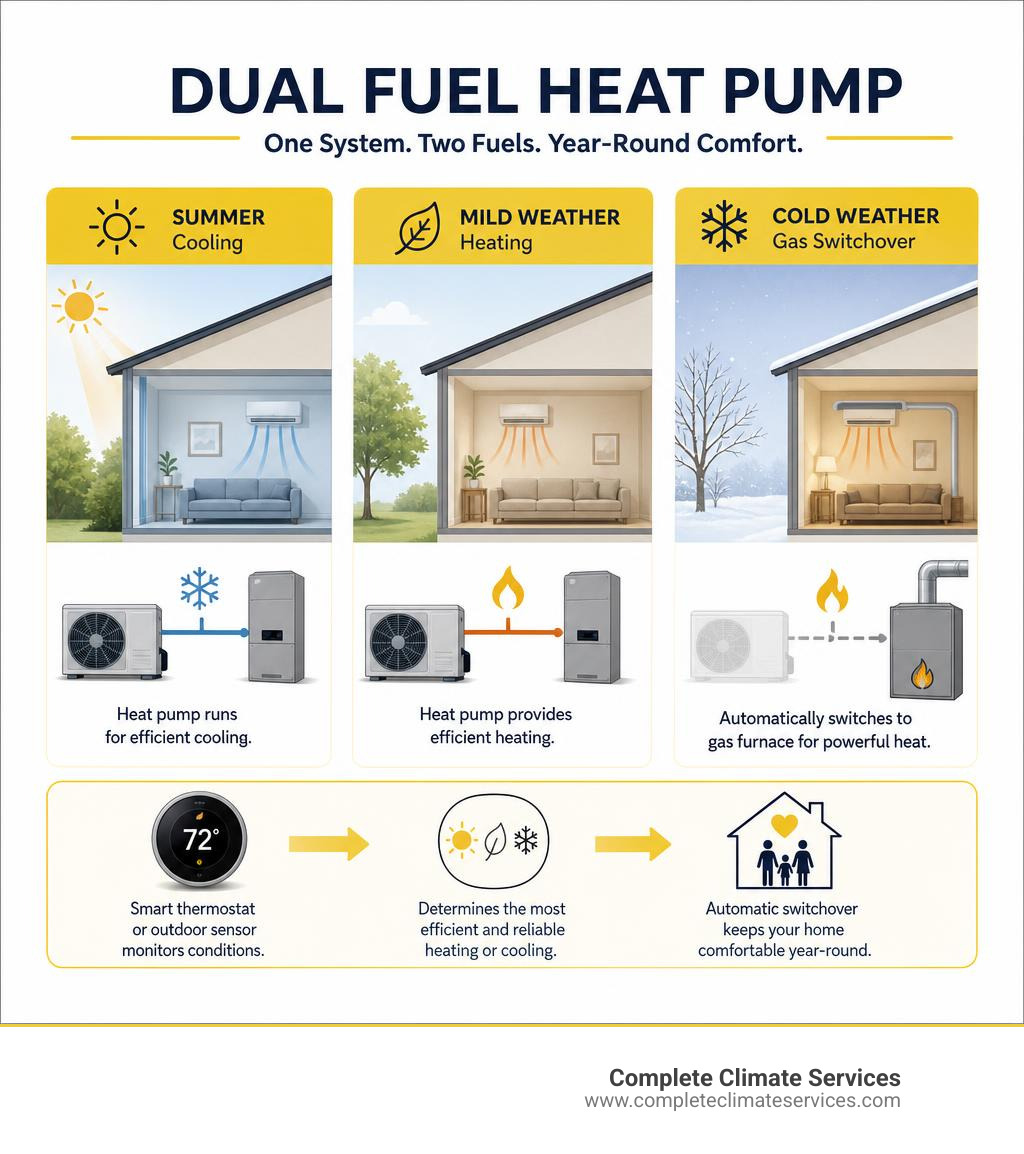
How does a dual fuel heat pump work? Here’s the short answer:
| Stage | What Happens |
|---|---|
| Mild weather (above ~35-40°F) | The electric heat pump runs, moving heat into your home at up to 300-400% efficiency |
| Cold weather (below ~35-40°F) | The system automatically switches to your gas furnace for powerful, reliable heat |
| Summer | The heat pump acts as a standard central A/C system |
| Switchover | A smart thermostat or outdoor sensor triggers the change, with no manual input needed |
The result: you always use the cheaper, more efficient fuel source for the conditions outside.
Most Baltimore homeowners are stuck choosing between two imperfect options. A gas furnace heats fast and handles brutal winters, but it runs on one fuel source no matter the conditions. A heat pump is incredibly efficient in mild weather, but it can struggle when temperatures drop well below freezing.
A dual fuel system gives you both. One system. Two fuel sources. Automatic switching.
Think of it like a hybrid car. It uses the electric motor when it’s efficient and the gas engine when you need more power. Your home comfort system works the same way.
At Complete Climate Services, our HVAC team has helped hundreds of Baltimore-area homeowners navigate the exact question of how does a dual fuel heat pump work and whether it’s the right fit for their home. In the sections below, we’ll walk you through everything you need to know to make a confident decision.
What is a Hybrid Heating System?
At its core, a hybrid heating system, commonly referred to as a dual fuel system, pairs an electric, air-source heat pump with a combustion furnace, which can run on natural gas, propane, or heating oil. Instead of relying on a single appliance to handle your home comfort year-round, a dual fuel setup splits the work between two distinct units, allowing each to run only when conditions are optimal.
To understand how this setup changes the game, let’s look at how these systems compare side by side:
| Feature | Standalone Gas Furnace | Standard Heat Pump | Dual Fuel (Hybrid) System |
|---|---|---|---|
| Primary fuel source | Natural gas / propane | Electricity | Electricity and gas/propane |
| Cooling capability | None (requires separate AC) | Yes (excellent efficiency) | Yes (excellent efficiency) |
| Mild weather heating (above 40°F) | Moderate efficiency (~95% AFUE) | High efficiency (200-400% COP) | High efficiency (runs heat pump) |
| Sub-zero heating (below 30°F) | Outstanding (hot, rapid airflow) | Can struggle / uses backup strip heat | Outstanding (switches to furnace) |
| Average equipment lifespan | 15-20+ years | ~15 years (runs year-round) | 20-25 years (shared wear and tear) |
By combining these components under one smart control system, you unlock real advantages from a dual fuel system. Instead of forcing an electric heat pump to work overtime in a January freeze, or burning expensive gas during a mild autumn afternoon, the system constantly pivots to the most cost-effective heating method.
Standard Heat Pumps vs. Gas Furnaces vs. Dual Fuel
To fully grasp why hybrid systems are such a breakthrough, it helps to understand the fundamental difference between how furnaces and heat pumps handle energy.
A gas furnace is a heat generator. It burns fuel to create combustion, heating up a metal heat exchanger. Air from your home is blown across this hot metal and distributed through your ductwork. While modern condensing furnaces are highly efficient, often achieving up to 95% energy efficiency, they can never exceed 100% efficiency because they have to create the heat.
An electric heat pump, on the other hand, is a heat transporter. It doesn’t create heat. It simply uses electricity and refrigerant to extract existing heat from the outdoor air and move it indoors. Because moving heat requires far less energy than creating it, heat pumps are incredibly efficient. In fact, during mild conditions, a heat pump can deliver up to three to four times more heat energy than the electrical energy it consumes. This translates to an astounding 300% to 400% efficiency.
However, as outdoor temperatures drop toward freezing, there is less heat available in the air for the heat pump to extract. The heat pump has to work much harder, its efficiency drops, and the air coming out of your registers can begin to feel lukewarm.
This is why we are seeing a major shift in how homeowners look at heating. In the right climate, heat pump systems are becoming more popular because of their unmatched mild-weather performance. But in a climate like Baltimore’s, where winter temperatures routinely plunge below freezing, relying solely on a standard heat pump can lead to high electric bills if the system has to rely on expensive electric resistance “strip” heat as its backup.
A dual fuel system solves this dilemma by offering built-in system redundancy. If your heat pump is working hard on a cold night, the system doesn’t turn on expensive electric backup strips. It simply fires up your gas furnace. This not only keeps your utility bills low but also provides a safety net: if one fuel source experiences an outage or equipment failure, you still have a fully functional secondary heating system to keep your pipes from freezing.
How Does a Dual Fuel Heat Pump Work?
The key to a dual fuel system is automation. You don’t have to watch the weather forecast, run down to the basement, or flip manual switches to change fuel sources. The entire process is handled seamlessly by smart controls and sensors.
A dual fuel system relies on a specialized thermostat, either an OEM communicating control or a smart thermostat equipped with auxiliary relays, paired with an outdoor temperature sensor. The thermostat monitors the outdoor temperature in real time. When you call for heat, the thermostat references its programmed “balance point” to determine whether the electric heat pump or the gas furnace is the most logical choice to run.
For homeowners comparing equipment options, professional heat pump services can help determine whether a standalone heat pump or hybrid setup makes more sense for the home, ductwork, and comfort goals.
The Role of the Heat Pump in Mild Weather: How Does a Dual Fuel Heat Pump Work?
During the spring, autumn, and mild winter days, typically any time temperatures are above 35°F to 40°F, the system relies exclusively on the electric heat pump.
In heating mode, the outdoor unit acts as an evaporator, absorbing ambient heat from the outdoor air. The compressor pumps the pressurized, hot refrigerant inside to the indoor coil. Your furnace’s blower fan then pushes indoor air across this warm coil, distributing comfortable air throughout your home.
Because the outdoor temperatures are moderate, the heat pump operates at peak performance, often maintaining a Coefficient of Performance (COP) between 3.0 and 4.0. This means you are getting maximum warmth while keeping your fossil fuel consumption at zero.
When summer arrives, the system reverses this process. The heat pump functions exactly like a standard central AC system, extracting heat from your indoor air and dumping it outside to keep your home cool and dry.
When the Furnace Takes Over: How Does a Dual Fuel Heat Pump Work in Extreme Cold?
When the outdoor temperature drops below the designated switchover threshold, the heat pump is locked out, and the gas furnace takes over as the primary heat source.
Instead of lukewarm air, the furnace delivers the rapid, high-temperature heat that gas systems are famous for. This is crucial for maintaining indoor comfort when the building envelope is losing heat rapidly to the freezing outdoor air.
The furnace also plays a critical role during the defrost cycle. When a heat pump operates in cold, damp weather, moisture can freeze on the outdoor coils. To melt this ice, the heat pump must occasionally enter defrost mode, which temporarily reverses the system back into cooling mode to send hot refrigerant to the outdoor coil.
Without a furnace, a heat pump in defrost mode would blow cold air into your home. In a dual fuel system, the furnace fires up during the defrost cycle to temper the air, ensuring your indoor comfort remains completely uninterrupted.
Finding the Balance Point: The Switchover Temperature
One of the most common questions we get at Complete Climate Services is: “At what exact temperature does the system switch from the heat pump to the furnace?”
The answer depends on finding the balance point. There are actually two types of balance points to consider:
- The thermal balance point: This is the outdoor temperature at which the heating load of your home exactly matches the maximum heating capacity of your heat pump. Below this temperature, the heat pump can no longer keep up with the heat loss of the building on its own.
- The economic balance point: This is the temperature at which it becomes cheaper to heat your home using gas, propane, or oil rather than electricity, based on your local utility rates.
We work closely with our customers to program the optimal switchover temperature, usually set between 30°F and 40°F, into their smart thermostat. This ensures that you aren’t just comfortable, but that you are actively saving the maximum amount of money based on current energy prices. For homeowners looking to maximize their system’s output, heat pump performance solutions can help fine-tune these settings.
Calculating the Economic Break Point
To find your home’s exact economic break point, we look at the efficiency of your equipment and compare the cost per Million British Thermal Units (MMBtu) of heat produced by each fuel source.
The formula compares:
- The cost of electricity per kilowatt-hour and the heat pump’s Coefficient of Performance (COP) at various temperatures.
- The cost of natural gas per therm or propane per gallon and the furnace’s Annual Fuel Utilization Efficiency (AFUE).
For example, if electricity rates in Baltimore are high but natural gas prices are relatively low, your economic balance point might be set slightly higher, around 40°F, to transition to gas sooner. Conversely, if you have solar panels providing cheap electricity, we can set the switchover point much lower, down to 30°F or even 25°F, to squeeze every bit of value out of your solar production before burning gas.
Key Benefits of Upgrading to a Hybrid System
Upgrading to a dual fuel system is a forward-thinking step in home climate control. It offers a triple win of efficiency, comfort, and long-term reliability.
When you invest in a hybrid system, you can expect several immediate advantages:
- Lower utility bills: By leveraging the heat pump during mild weather and the furnace during extreme cold, you avoid the most expensive operating conditions for both units.
- Superior comfort: Many homeowners complain that standard gas furnaces produce air that is dry and “scorching,” which can lead to dry skin and static electricity. A heat pump provides a gentler, more humid heat during the autumn and spring, while the furnace is ready to deliver fast, powerful heat when real winter hits.
- Extended equipment lifespan: Because the heat pump doesn’t have to struggle through sub-zero freezes, and the furnace gets to rest entirely during the spring and fall, both components experience significantly less wear and tear. This is why a well-maintained dual fuel system can often deliver a long service life.
- Environmental responsibility: Because a heat pump can reduce electricity use for heating by about 50% compared to furnaces or electric baseboards under the right conditions, you significantly lower your home’s seasonal carbon footprint.
Understanding Efficiency Ratings: SEER2, HSPF2, AFUE, and COP
When shopping for a dual fuel system, you will encounter several key efficiency metrics. Understanding these terms will help you choose the right tier of equipment for your budget:
- SEER2 (Seasonal Energy Efficiency Ratio 2): Measures the cooling efficiency of your heat pump during the summer. Higher numbers mean lower electric bills in July.
- HSPF2 (Heating Seasonal Performance Factor 2): Measures the heating efficiency of the heat pump over an entire season.
- COP (Coefficient of Performance): The real-time measurement of how many units of heat energy the system delivers for every unit of electricity it consumes. For example, a COP of 3.0 means 300% efficiency.
- AFUE (Annual Fuel Utilization Efficiency): Measures the annual efficiency of your furnace. A 95% AFUE furnace converts 95% of the fuel it burns into usable heat for your home, while venting the remaining 5% outside.
Choosing a system with variable-speed, inverter-driven technology allows the heat pump to modulate its capacity up and down in tiny increments. This keeps your home at a steady temperature while operating at maximum possible efficiency.
Climate Suitability: Is Dual Fuel Right for Your Home?
Dual fuel systems are not a one-size-fits-all solution, but they are uniquely suited for specific climates.
If you live in a region that stays warm year-round, a simple heat pump is all you will ever need. If you live in an area with brutal, unrelenting sub-zero winters and very low natural gas costs, a standalone high-efficiency gas furnace might be the most practical choice.
However, if you live in a region with four distinct seasons and highly fluctuating winter temperatures, dual fuel can be an excellent fit.
This is precisely why these systems are so effective right here in Maryland. Our winters bring a mix of mild 50°F afternoons and freezing 15°F nights. Maryland’s climate perfectly matches the operational sweet spot of hybrid technology.
Sizing, Installation Costs, and Maintenance
Because a dual fuel system involves two major pieces of HVAC equipment working in tandem, proper design and installation are critical.
At Complete Climate Services, we always begin with an ACCA Manual J load calculation to determine the exact heating and cooling needs of your home. Sizing a dual fuel system is unique because the heat pump can often be sized to meet only part of your peak winter heating load. The gas furnace is there to handle the extreme peaks, allowing us to install a quieter, properly matched heat pump unit that will dehumidify and cool your home in the summer without short-cycling.
For homes that need dependable comfort in both mild and freezing weather, dual fuel system service gives homeowners a practical way to combine heat pump efficiency with furnace backup in one coordinated HVAC setup.
Costs can vary significantly depending on the size of your home, the efficiency ratings of the selected equipment, and whether you need gas line modifications or ductwork repairs. While the upfront cost is higher than a single standalone system, the year-round utility savings and shared equipment workload can improve long-term value.
To protect this investment, regular maintenance is non-negotiable. We recommend scheduling bi-annual professional tune-ups: once in the spring for the heat pump’s cooling system, and once in the autumn to perform a combustion analysis and safety check on the furnace. Between visits, make sure to change your air filters every 1 to 3 months and keep the outdoor unit clear of leaves, snow, and debris. If you notice a sudden spike in your utility bills, or if the system is struggling to switch between fuel sources, it may be time for expert heat pump repair guidance.
Sizing and Ductwork Considerations
When retrofitting a heat pump onto an existing gas furnace, we must carefully evaluate your home’s ductwork.
Gas furnaces are designed to move a relatively small volume of very hot air. Heat pumps, however, require a higher volume of slightly cooler air to deliver the same amount of heat. This means a heat pump often requires larger ductwork and lower static pressure to prevent noisy airflow and premature equipment wear.
Our team performs a thorough static pressure test during our initial home audit to ensure your existing duct system can handle the airflow requirements of a hybrid setup without restricting performance.
Incentives, Rebates, and Tax Credits
The financial transition to a hybrid system may be easier with available incentives and rebates.
Depending on the equipment selected and current program rules, homeowners may qualify for federal tax credits on qualifying high-efficiency heat pumps or furnaces.
Maryland utility rebate programs may also offer incentives for upgrading to high-efficiency heat pump systems. When we design your system, we can provide an itemized breakdown of current federal tax credits and utility rebates you may qualify for, and we can help you handle the paperwork.
Frequently Asked Questions about Dual Fuel Systems
Can I add a heat pump to my existing gas furnace?
Yes. In many cases, if your existing gas furnace is relatively new and in good working condition, we can perform a hybrid retrofit. We install a compatible outdoor heat pump unit, mount a new evaporator coil on top of your existing furnace, and upgrade your thermostat to a dual fuel-compatible smart controller. This allows you to gain the efficiency benefits of a heat pump without paying for a brand-new furnace.
Does a dual fuel system work during a power outage?
No. While the furnace uses gas or propane to generate heat, it still requires electricity to power the control boards, the ignition system, and the heavy blower motor that pushes air through your vents. Similarly, the heat pump relies entirely on electricity to run its compressor and outdoor fan. To keep your system running during a power outage, you will need a backup home generator or a solar battery storage system.
How long does a dual fuel heat pump system last?
When properly installed and maintained, a dual fuel system can last for many years. Because the heating load is shared between the heat pump and the furnace, neither component is forced to run during its least efficient, most stressful operating conditions. This can reduce component wear and tear compared to standalone systems that run solo year-round.
Conclusion
Understanding how does a dual fuel heat pump work is the first step toward taking complete control of your home’s comfort and energy bills. By combining the high efficiency of an electric heat pump with the heating power of a gas furnace, a hybrid system offers a strong solution for Maryland’s unpredictable, four-season climate.
At Complete Climate Services, we have spent over 20 years providing honest, reliable HVAC service to our neighbors throughout Baltimore, Columbia, Towson, Ellicott City, and the surrounding areas. Our 5.0-star rating across platforms is a testament to our commitment to doing the job right the first time, with transparent recommendations, expert load calculations, and matched system installations.
If you are ready to stop compromising on your comfort and start saving on your monthly utility bills, contact our dual fuel system specialists today. Let our family take care of yours!

